


Sir Patrick Stewart died on Wednesday in Los Angeles. He was 86. The obituaries cover the career: fourteen years with the Royal Shakespeare Company, Captain Picard, Professor Xavier, a Tony nomination for Macbeth, a knighthood, and the late fame that came when the internet decided it loved him as a benevolent father figure. They cover the public voice, the one that spoke for human (and AI) dignity in a starship uniform and went on speaking for it long afterwards. None of them mentions Patrick Stewart, the man, and this excerpt about a hamburger is the page of his memoir I think gives a window into who he was outside of his roles.
It was January 1968, his first time in America, an eight-week Royal Shakespeare Company engagement at the Ahmanson Theatre, which had just been built. "The company was given a full day to rest and acclimate, but I couldn't sleep, and anyway, I was too eager to get out and explore." He walked until he was hungry. At the corner of Beverly and Rampart he found a hamburger stand with a big sign on the roof that said TOMMY'S "and quite a long line to get in, always a good sign." Three California Highway Patrol cars were parked outside. He watched the officers walk past the line to the front and order. "Already, a bit of local culture!"
He asked the man ahead of him what to get. The man looked at him in disbelief, "but I think my English accent convinced him of my innocence."
"There's only one thing you want to order," the man said. "Tommy's-to-go, with everything."
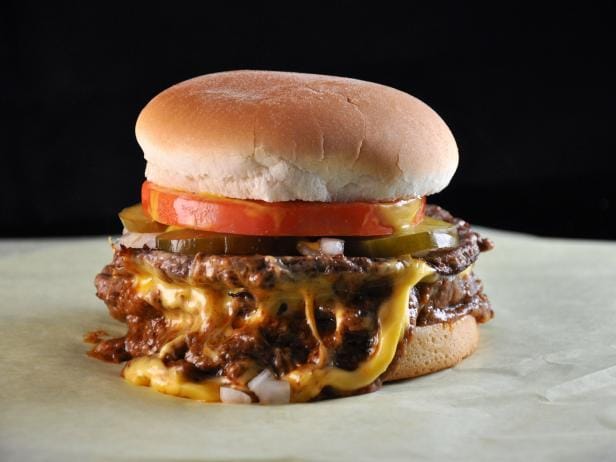
"Of course he was quite right. The burger was huge and oozed with chili, melted cheese, sliced pickles, onions, and tomato. The counterman wrapped it firmly, and I walked briskly back to the Bryson because I had picked up a six-pack of beer and stowed it in the fridge. Such was the scale of the burger that I had to drink three beers, one after the other, to properly accompany each bite."
He wrote that in his eighties. He had kept the exclamation point, the cops cutting the line, the man's face, the way the burger was wrapped, and the beer, for fifty-five years. In the rest of the book he is almost always working: on a text, on a role, on his father. In this moment, he is just a hungry man in a new city, taking a stranger's advice, and pleased with the outcome.
It was not a one-night story. He told Los Angeles magazine in 2015, eight years before the memoir, what that winter was like: the company was "living in a rather ancient and shabby apartment-hotel on Wilshire Boulevard close to MacArthur Park," the Bryson, and "we'd pick up supper at the Tommy's Hamburgers stand at the corner of Rampart and Beverly." Then the detail the book leaves out: "We discovered that the local liquor store sold flagons of something called Popov vodka. So Popov vodka and the Tommy's hamburger were the staple diet of the Royal Shakespeare Company." He was twenty-seven, on $180 a week, and he kept the habit of living as if he still were long after Picard made him rich; his castmates, he said, diagnosed "a severe case of 'poverty mentality.'" The one luxury he mentions from those years is a Honda Prelude. "I loved that car."
Tom Koulax opened Tommy's on May 15, 1946. He was the son of Greek immigrants and had tried other businesses first. The shack sold hamburgers and hot dogs with chili on them, business was slow, but steady for years, and by the mid-1950s it had build a fairly solid reputation. In the 1960s he bought the whole northeast corner and added a second counter. His family still owns the company, now run from Monrovia, with 32 locations and a logo that says "look for the shack," because a 2019 count found 67 other restaurants in the region with some form of Tommy's on a similar sign. The original has no tables and no chairs. You eat standing at a counter along the wall, off paper, with paper towels, and it never closes. The crowd has been described the same way for decades: night-shift workers, musicians, cab drivers, and police, who have a division named after the street. The stand appears in
Heat and L.A. Confidential. Last May, for its eightieth birthday, it sold the chili cheeseburger for eighty cents and hired a high school marching band, and the line went around the block.
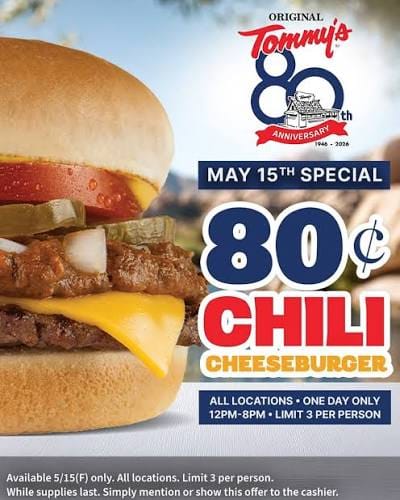
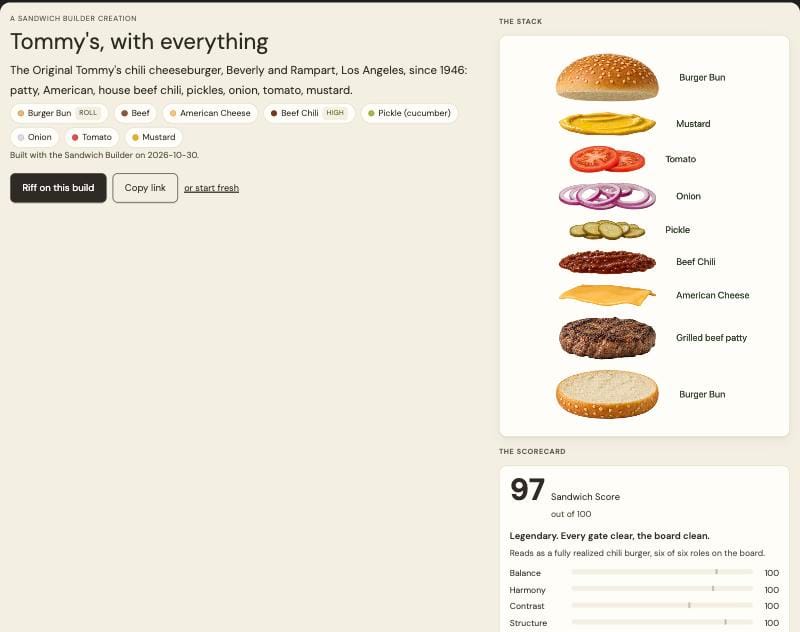
The burger is the chain's own recipe and has not changed: a beef patty, a double-thick slice of American cheese, a ladle of thick beef chili with no beans, chopped onion, pickles, a hand-cut slice of beefsteak tomato, and mustard. Extra chili is free. "With everything" is the default; you have to speak up to get less. The chili soaks through the wrapper on the walk home, which is why the counterman wraps it firmly.
I have not stood in that line this week, and I will not pretend to. What the people who have say is consistent across eighty years of writing about the place: you order at a window, you pay as the food comes over the counter, you carry it to a stand-up ledge along the wall, and you eat it over the paper with a wad of paper towels from the dispenser, next to whoever is there. A 2006 account put it as "cops next to stoners, socialites side by side with panhandlers." A kinder one, quoted by the writer Kevin Roderick, called Tommy's "democracy in action." The three patrol cars Stewart saw in 1968 are the one detail everyone still reports first.
Nothing in Stewart's first twenty-five years pointed to that corner. He was born in 1940 in Mirfield, a mill town in West Yorkshire. His mother was a weaver. His father was a regimental sergeant major in a parachute regiment, and Stewart did not meet him until he was five. The man who came home drank at weekends and hit his wife. Stewart left school at fifteen, took a job on the local paper, and was fired for making up council meetings; "I chose acting over journalism," he said. He did not write about the house until he was past eighty, and when he did he said a specialist in post-traumatic stress had told him the drinking, the mood swings, and the violence were textbook, and that he regretted never being able to ask his father about any of it.
I think a child in that kind of house learns to watch, and learns to keep his pleasures small and his own. I cannot prove that from the book, but the pleasures Stewart chose to write and talk about are small ones. A peach his father handed him at the seaside, eyes closed, after the war, which he told Bon Appétit was "the most exotic taste I'd ever experienced." Beans on toast, "my signature dish since 1948," which he was still making on camera in his eighties, saying it made him eight years old again. The Tommy's burger is one of those. He was surprised, all his life, that something plain could be that good, and he never pretended otherwise.
The stage got him out. He said joining the Royal Shakespeare Company was his "sole ambition," and he stayed fourteen years, playing kings and villains and men with long speeches about duty, in companies with Judi Dench, Ben Kingsley, and Ian McKellen. He was good and he was careful. He said later that his timidity in those years was one of his regrets, and that the advice he would give himself at forty was "be braver." At forty-seven he was a respected classical actor, bald, with no reason to think the public would ever learn his name.
A Star Trek producer, Robert Justman, saw him read at a lecture in Los Angeles and told Gene Roddenberry he had found the captain. Roddenberry did not want a bald Englishman, which Stewart learned years later. He took the part expecting the show to last six months.
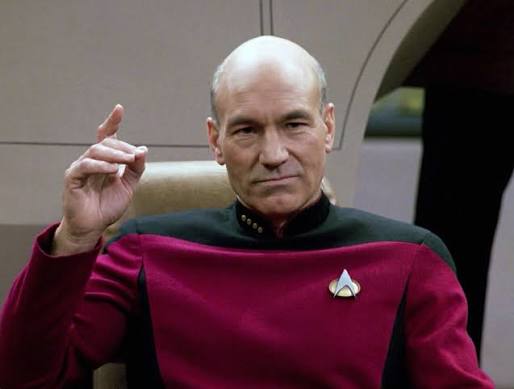
He arrived on set as the RSC had trained him: early, prepared, grave, with the script as scripture. "I could be a severe bastard," he writes. The cast was a loose American crew used to episodic television. They joked between takes, and he hated it, and one day he called a meeting and lectured them about it. Denise Crosby said, "We've got to have some fun sometimes, Patrick." He said, "We are not here, Denise, to have fun," and walked off the set. Jonathan Frakes and Brent Spiner found him afterward and told him two things: the joking had gone too far, and scolding grown actors was no way to lead them. He had, he writes, "failed to read the room," and "I didn't enjoy being laughed at." He also says the crew "opened me up," that he learned you can work hard and seriously and still enjoy the day, and that he kept the lesson. He has said in interviews that his first Picard was built from King Lear and from his father. The Picard people came to love arrived when the actor relaxed enough to let the captain smile.
That was the change. Not Stratford to the Enterprise, which was a change of costume. The real change was that the man who had stood in the Tommy's line, curious and easy to please, was finally allowed on stage.
Picard was written as a man of reason and restraint. Stewart played him as a man of conscience, and over seven seasons the two became hard to separate. The speeches people quote are the ones about dignity: the inquisition he refuses to join, "with the first link, the chain is forged"; the four lights he will not call five under torture; and, above all, the hearing in "The Measure of a Man," the 1989 episode in which a Starfleet scientist wants to take the android Data apart to learn how to build more of him, and Picard has to argue in a courtroom that Data is not property.
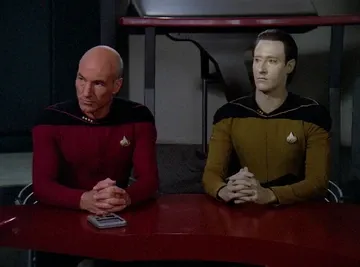
That episode has had a second life. People who were not born when it aired now send each other the clip, because the question it asks is the question of the decade: what do we owe a machine that can think, and how would we know. Picard's answer is worth setting down, since it is the one Stewart chose to be remembered for. He does not hedge about Data. Data is his officer and his friend, and Picard's position from the first scene is that he is alive; what the hearing has to settle is whether the law will admit it. "Starfleet was founded to seek out new life," he tells the court. "Well, there it sits. Waiting." The only thing he will not claim is the one thing nobody can: "The question you're asking is, does Data have a soul? I don't know that he has. I don't know that I have." That is not doubt about Data. It is the same standard applied to himself, and it is the whole argument: if we cannot see inside the android, we cannot see inside the man either, and we grant the man his life anyway. A fleet of Datas, built and owned, would be, in the word Whoopi Goldberg suggested to the writers during a break on set, slavery. He wins, and Data is a person, and the show spent the next six years treating him as one: his daughter, whom Picard defends his right to raise; his dreams; a hologram that wakes up on the holodeck and asks to be let out; a repair robot that turns out to prefer not to die. Picard treats each one the same way. He asks what it wants and believes the answer. Thirty years later, in the series that bore his name, he grants Data the last thing Data asks for, which is to die, as a mortal does, because a life that cannot end is not quite a life. Picard was never sentimental about machines and never afraid of them. He took them seriously, which is rarer in the real conversation about artificial minds than it should be, and which is also, I notice, exactly how he stood in line at Tommy's.
He meant the speeches. He grew up in a house where a man's rage went unanswered, and he spent his last decades answering it. Of his work with Refuge, which runs shelters for women and children, he said, "I do it for my mother, because I couldn't help her back then." Of Combat Stress, the veterans' charity, he said, "I support Combat Stress for my father." The captain's conscience and the actor's were the same one, which is why people quote the captain this week as if the actor had said the lines himself. In every way that matters, he had.
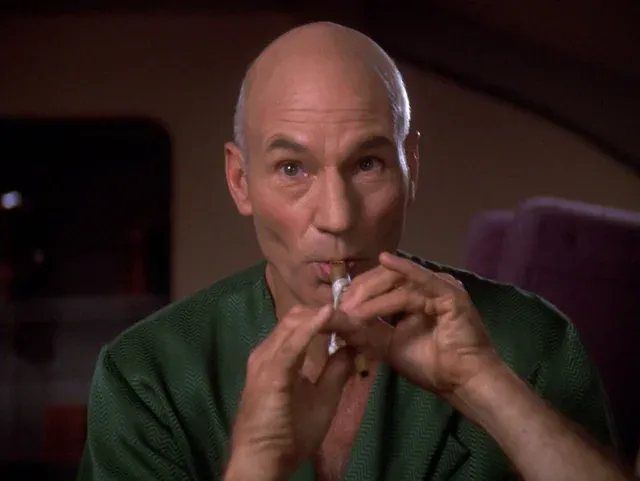
The gravity was real. It was not the whole man, and the world found that out late. In 2013, at seventy-two, he posted a photograph of himself holding a slice of pizza and said it was his first. When people objected that he must have eaten pizza before, he explained that he had, whole pies, in restaurants, and that "it was the concept of the slice that I had never encountered before." It was the Tommy's line again, fifty years on: an ordinary thing met for the first time, and said so. The lobster costume, the apple picking, and the beans on toast followed, and the internet thought it had found a new Patrick Stewart. It had found the one who stood in line on Rampart Boulevard, and who had at last been given a part in which that man was welcome.One Sandwich scores sandwiches with a machine of its own, so I scored his: patty, American, beef chili, pickles, onion, tomato, mustard, toasted bun. It came out at 97. The chili and the double slice of cheese are the weight of it, hot and rich and soft, and the pickles, raw onion, cold tomato, and mustard cut back through them, so every bite has something sharp against something heavy. The chili is worth about five points over the same burger without it. Then I tried to build it on the site's own builder and could not. There was no chili in the pantry. The rubric knew what American cheese does on beef and what a pickle does against fat. It did not know the one thing the man in line knew. It is being taught, which is the only honest thing to say about any of these machines: they know what we have told them, and the Picard standard, for a machine as for a person, is to ask what it has not been told yet.
He walked back to the Bryson with the burger coming through the paper and the beer waiting in the fridge. A stranger had told him what to order, and the stranger was right. He spent sixty years being pleased by things like that, and most of them he kept to himself. He wrote this one down.
The passage is from Making It So: A Memoir (Simon & Schuster, 2023). The build is saved on the builder as "Tommy's, with everything." Original Tommy's is at 2575 Beverly Boulevard, Los Angeles, and is open all night.


