


We are not here to relitigate whether a hot dog is a sandwich. It is bread enclosing a filling; the court sees no further questions. We are here because the most famous sandwich-adjacent object in America, the Costco hot dog and soda combo, has cost $1.50 since the Reagan administration, sold 245.1 million units last fiscal year, moved a company's stock when a Wendy's fry cook tweeted a joke about it, and carries a founding legend in which one of the great retailers of the twentieth century threatened to kill his own CEO over a quarter.
The record on this hot dog is enormous and contradictory: two competing origin stories, three different years for when Costco started making its own franks, a factory that executives place in Los Angeles but that every public document puts 370 miles north of there. What follows is the strongest version of each fact, with the disputes flagged where they matter and a link on every claim that deserves one. Pack a lunch. Ideally a $1.50 one.
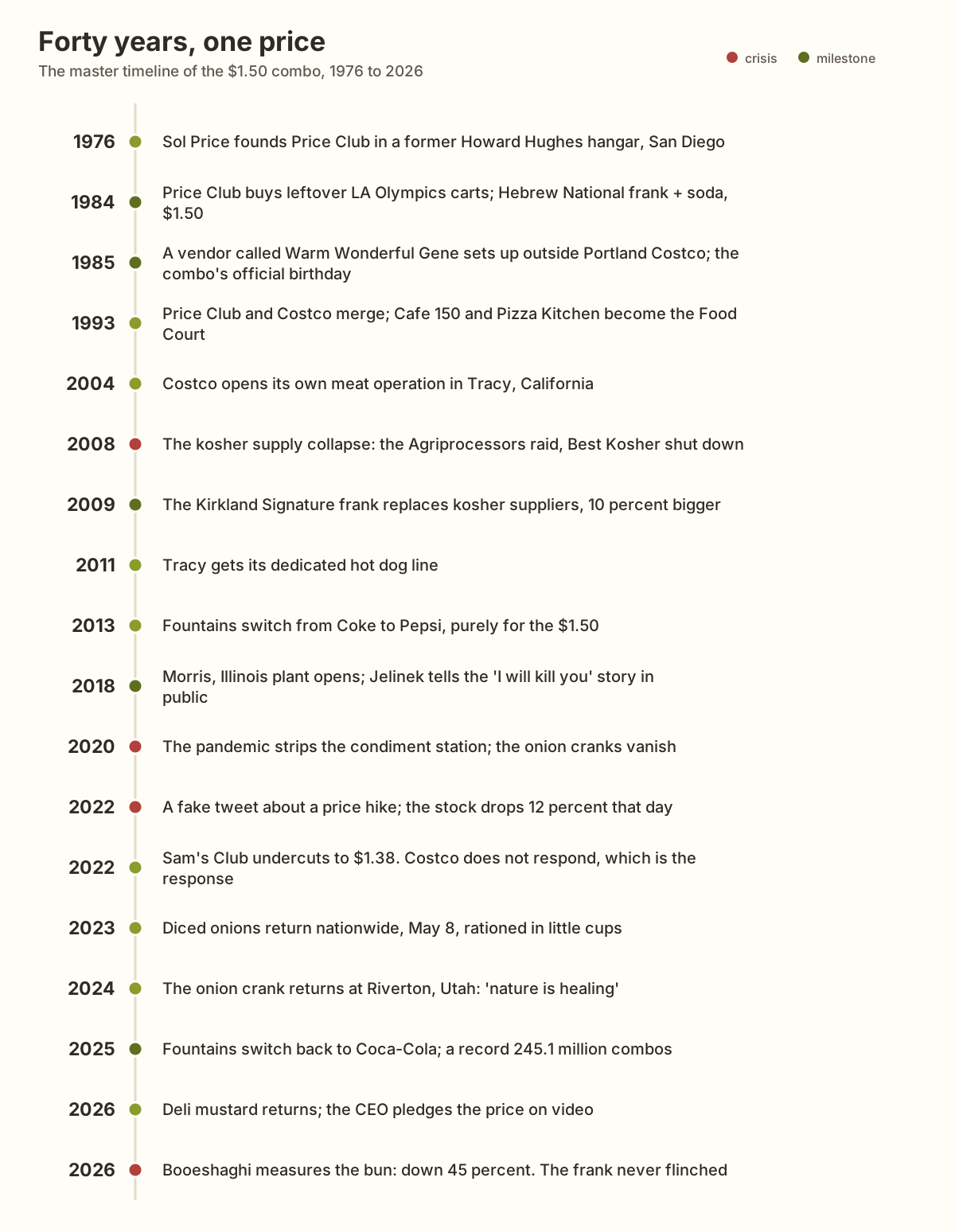
Part One: Two Carts, Two Companies
The standard telling begins with a single hot dog cart in 1984. The truth is better: there were two carts, at two different companies, and the modern Costco hot dog descends from both.
The first belongs to Price Club, the warehouse pioneer that Sol Price founded in 1976 in a former Howard Hughes aircraft building on Morena Boulevard in San Diego. According to the biography written by his son Robert, and retold in The Ringer's definitive 2026 feature, Sol Price and his lieutenant Richard Libenson watched vendors angling to sell food to the crowds outside their warehouse and reached a characteristically blunt conclusion: if anyone was going to sell hot dogs at the Price Club entrance, it should be Price Club. In 1984 the company bought up hot dog carts left over from that summer's Los Angeles Olympics and started selling Hebrew National franks with a soda for $1.50 outside the Morena Boulevard flagship. That was the first official rollout of the combo, at the price it still carries today. The motive was pure Sol Price, a man whose operating philosophy included the line "I have a fiduciary duty to my members, like a lawyer to clients," and who priced the dogs at cost, maybe at a loss, on the theory that nobody else should profit off his members' foot traffic.
The second cart belongs to Costco itself, then a separate two-year-old Seattle company founded by Price's former protege Jim Sinegal and Jeffrey Brotman. According to David and Susan Schwartz, authors of The Joy of Costco, as told to USA Today, the Costco-side hot dog program began in 1985 outside a Portland, Oregon warehouse, where general manager Joe Portera let a vendor known only as "Warm Wonderful Gene" set up a hot dog cart without corporate approval. Instead of shutting it down, executives expanded on it. Portera went on to become a Costco executive vice president, and Gene went on to become a footnote in one of the great pricing stories in retail.
Most press accounts compress all of this into "a Hebrew National cart outside a San Diego Costco in 1984," which is almost certainly a conflation: Costco had no San Diego warehouse in 1984, but Price Club's flagship was there. The two companies ran parallel food programs for a decade. Costco branded its stand "Cafe 150," named for the price of the combo; Price Club's operation was called the Pizza Kitchen. Through about 1991 the hot dogs still sold from standalone carts resembling beach vendor stands, and the menu was hot dogs and soda, full stop. When the companies merged in 1993 to form PriceCostco, with 206 warehouses and $16 billion in sales, the food operations merged too, the names giving way to the plain "Food Court," and pizza, churros, salads, and ice cream filled in around the dog.
One date needs pinning down, because it governs every anniversary and every inflation calculation: sources split between 1984 and 1985 for the start of the $1.50 combo. Price Club's carts sold it in 1984. Costco's own anniversary math, which celebrated the combo's 40th birthday in fiscal 2025, points to 1985. Both are defensible. The price, in any case, has not moved in four decades.
Part Two: The Kosher Era and How It Ended
For roughly its first quarter century, the Costco hot dog was a kosher hot dog, and its ending involved a federal immigration raid, a corporate collapse, and a customer petition drive, which is more drama than most quarter-pound franks ever see.
The original supplier was Hebrew National, the storied kosher brand that passed through Riviana Foods before landing with ConAgra in 1993. But Hebrew National was never the whole story. Depending on the region, Costco food courts also served franks from Sinai 48, a Chicago label of Best Kosher Foods, a company whose roots ran back to 1886, when a German-Jewish immigrant named Isaac Oscherwitz started making sausage in Cincinnati. Forum posts from the era capture the regional patchwork: shoppers in some markets remembered only Sinai dogs going back to the cart days, while others watched their warehouses switch from Hebrew National to Sinai during 2008.
By the late 2000s the arrangement was collapsing from three directions at once. First, the economics had gone sour. Craig Jelinek, then Costco's president, would later recall telling Sinegal the company was "losing our rear ends" selling the combo at $1.50. Richard Galanti, Costco's longtime finance chief, put the supplier side of it plainly in a Stanford Business interview relayed by Mashed: "Because of our volume, we were driving up their prices." Both Hebrew National and Sinai 48 reportedly declined to expand capacity even when Costco offered long-term contracts to fund it.
Second, the kosher meat industry itself was in crisis. In May 2008, federal agents raided Agriprocessors, the Postville, Iowa plant that was then the largest glatt kosher beef processor in the country, in what was at the time the largest single-site immigration raid in American history. The company lost its certification and collapsed into bankruptcy, and the Orthodox Union's Rabbi Menachem Genack acknowledged the obvious: "There's no question that the plant going offline creates a real supply issue for kosher meat." Then in November 2008, Sara Lee announced it was exiting the kosher meat business entirely, shutting down Best Kosher, Sinai 48's parent, by January 2009 and idling its Chicago plant.
Third, Costco had a replacement ready. The company's own magazine, the Costco Connection, laid out the official story in March 2009: Costco had "become concerned in 2007 over troubling signs in the kosher meat industry," and by the end of 2008 one original supplier had exited the business, a major supplier had closed, and Costco's own frank was ready for testing. The article made a further argument that kosher certification had originally served, back in 1984, as a proxy for quality, and that modern USDA inspection had made the proxy unnecessary. The new Kirkland Signature dog would be about 10 percent heavier and longer, made from "100 percent beef with only fresh USDA Choice or better cuts," with no fillers, binders, phosphates, corn syrup, or artificial colors and flavors, and the company said it had "won consistently" in blind taste tests.
Not everyone was consoled. In March 2009 a petition circulated online under the banner "Bring Back Kosher Hot Dogs to Costco Snack Bar," with signers offering to pay $1.75 or even $2.00 for a kosher dog. It went nowhere. No Costco food court anywhere serves a kosher hot dog today, though Hebrew National's packaged franks still sit in the cold cases a few aisles from the counter that dropped them. There is a small historical irony here: Costco left Hebrew National partly over anxieties about kosher supply, and in 2012 Hebrew National itself was sued by consumers claiming its hot dogs were not actually kosher. The case was dismissed on the grounds that courts cannot adjudicate religious law.
Part Three: The Threat
The pivot from buying franks to making them produced the most famous quotation in warehouse club history, and it is worth getting the provenance exactly right, because the story is true.
On April 12, 2018, Craig Jelinek, by then Costco's CEO, gave a talk at an Issaquah, Washington chamber of commerce luncheon, covered by the local magazine 425 Business. He told the audience about going to Jim Sinegal years earlier with the obvious business-school move: "Jim, we can't sell this hot dog for a buck fifty. We are losing our rear ends." Sinegal's answer: "If you raise the effing hot dog, I will kill you. Figure it out." Snopes rated the exchange true, reasoning that a CEO telling the story on himself in public is about as good as sourcing gets. In a later Fortune retelling, Jelinek added his own deadpan coda: "That's all I really needed."
Sinegal was consistent on the subject. In a November 2009 Seattle Times interview, asked what it would mean if the price ever went up, he answered, "That I'm dead." He explained the underlying logic elsewhere: "Because everybody talks about it. We're known for that hot dog. That's something you don't mess with." And he understood the price as a signal about the whole company: the same dog a ballpark sells for seven or eight dollars, at a fifth of the price, every day, forever.
Jelinek figured it out, and the way he figured it out is the hinge of the entire story: Costco became a hot dog manufacturer.
Weird History Food on the loss-leader question. Video: Weird History Food, YouTube.
Part Four: The Meat
Start with what the frank actually is, because Costco publishes the label. The Kirkland Signature Beef Dinner Frank, identical in the food court and the retail cold case, is a 123 gram link, about 4.4 ounces, sold at retail in 14-link, 3.81 pound packages. Costco's own copy calls the format "1/4 lb Plus," 8 percent larger than a standard quarter-pound link; the company's food court operations chief has put the growth at 9 percent over the original, and the 2009 Costco Connection said 10. Whichever figure you take, the dog got bigger when Costco took over production, not smaller.
The ingredient list is short: beef, water, dextrose, salt, spices, sodium lactate, garlic, sodium diacetate, sodium erythorbate, paprika and paprika extractive, and sodium nitrite for the cure. Each link carries about 370 calories, 31 grams of fat, 16 grams of protein, and roughly 1,250 milligrams of sodium; the assembled dog and bun runs about 580 calories, and the full combo about 1,750 milligrams of sodium, most of a day's recommended intake in a single sitting.
What is absent from that label is the food-science story. Nearly every mass-market frank uses phosphates, the industry's standard tool for binding water and fat into a stable emulsion. Costco's has none. The practical way to pull that off is to use enough high-quality skeletal muscle meat, and the label backs it up: fresh USDA Choice or better beef, no mechanically separated anything, no byproducts, no corn syrup. Compare the classic Oscar Mayer wiener, which lists mechanically separated turkey, chicken, and pork alongside corn syrup and sodium phosphate. The dextrose supplies the faint sweetness people notice in the Costco dog, the garlic and paprika do the seasoning, and the lactate-diacetate pair handles shelf life. The frank appears to be skinless, cooked in a removed cellulose casing rather than a natural one, though Costco has never said so on the label; the strongest evidence is reviews from natural-casing loyalists who note the difference and love it anyway.
Part Five: The Factories
Ask a Costco executive where the hot dogs are made and you may get the wrong answer. Jelinek told his 2018 audience that Costco "built its own hot dog plant in Los Angeles" and later opened a second in Chicago, and national outlets have repeated it ever since. The public record tells it differently. Every verifiable document puts Costco's California meat operation in Tracy, in San Joaquin County, at 17880 West Schulte Road, 370 miles north of Los Angeles; there is even a construction-industry record for a project bluntly titled "Kirkland Hot Dog Plant, Tracy, CA." The second plant is in Morris, Illinois, an hour southwest of Chicago. The executives' geography is best read as shorthand. The deeds are not.
The Tracy story starts before hot dogs. Costco established a meat operation there in 2004, initially focused on ground beef; a mid-2000s trade press profile described an 80,000 square foot facility running automated lines at 45 ten-pound chubs a minute. When the hot dog decision came, Tracy grew into the job: later reporting describes a roughly 250,000 square foot plant producing hot dogs, hamburger patties, ground beef, Polish sausages, and meatballs. Sources disagree on exactly when the first Kirkland frank rolled off a Costco line, and the honest answer looks like a phased transition: the frank was developed and testing by late 2008, rolled through food courts in 2009, and Wikipedia dates Tracy's dedicated hot dog line to 2011. By recent estimates the plant turns out more than 200 million hot dogs a year, and its ground beef operation produces about half a million pounds a day.
Tracy is also where Costco's unusual food safety regime lives. The plant does not slaughter; it buys beef from outside packers, requires each lot certified E. coli negative before shipment, retests incoming loads, and tests finished product again before release. A Seattle Times investigation reported that for a period Costco conducted more E. coli testing than the USDA did across all other American beef plants combined. Craig Wilson, the company's food safety chief, framed the philosophy memorably: "Food safety is an oxymoron... we are results-driven and more nimble than the government." Notably, no recall of Kirkland Signature hot dogs has ever been recorded, a clean sheet across nearly two decades at colossal volume.
The Morris, Illinois plant opened in 2018 to feed the eastern half of the country, and its construction record gives the best available sense of what the $1.50 price actually requires: 255,000 square feet on a 60-acre site, five production lines making ready-to-eat hot dogs and meatballs, ten-pound ground beef chubs, frozen patties, and organic ground beef, with more than a mile of conveyor belts, five and a half miles of piping, and a dedicated refrigeration engine room. County records put employment at 561; federal filings for a later period count 681. The Joy of Costco adds that in-house hot dog production, together with a switch to concentrated pizza sauce, saves about $2.2 million a year in shipping alone.
This is the answer to the question every profile of the hot dog eventually asks. Other retailers hold a price by squeezing suppliers or shrinking the product. Costco held it by building two federally inspected meat plants. The frank got bigger, the supplier margin disappeared, and the $1.50 survived.
The factories, animated. Video: threaded., YouTube.
Part Six: The Bun, or the Secret Life of the Sandwich Part
Now we arrive at this publication's natural jurisdiction. The frank is one recipe made in two company plants. The bread it rides in is the opposite: a deliberately unstandardized patchwork that Costco does not make, has never publicly discussed, and sources from at least four regional bakeries, which is why the "same" $1.50 hot dog is a sesame-seeded experience in Sacramento, a plain roll in Cleveland, and a challah situation in Atlanta. The frank is a monolith. The bun is a quilt with a hundred and forty years of American baking history sewn into it.
Costco has never published its bun contracts, so the supplier map has been assembled the hard way, by shoppers, employees, and food writers matching food court buns to bags in the bread aisle. The core method, documented by Mashed from employee comments in a 2020 Reddit thread, is delightfully simple: in most regions, the food court's bun brand is quietly for sale a few aisles away.
The West Coast rides on Francisco. Los Angeles and Bay Area food courts use sesame-seeded rolls from Francisco, sold at retail "with a maroon label," per a Costco employee, and available at Costco Business Centers as Francisco Gourmet Seeded Hot Dog Rolls, item #977337. The lineage behind that maroon label is the deepest in the whole story. Francisco descends from the San Francisco French Bread Company, the entity that combined Parisian Bakery, founded in 1856, and Colombo Baking, founded in 1896, two pillars of San Francisco sourdough history. The combined company passed to Hostess in the 1990s, went down with Hostess's 2012 liquidation, and was scooped up by Bimbo Bakeries USA in 2014. The bread under the West Coast's most famous $1.50 hot dog carries Gold Rush era baking DNA and a Mexican multinational's ownership papers.
The Southeast eats challah, basically. Southern food courts are supplied by Engelman's Bakery of Norcross, Georgia, founded in the early 1980s by Sammy Engelman and his sister Miriam, children of a family that ran a bakery in Israel before immigrating to New York in 1961. Engelman's is now a 50,000 square foot wholesale operation, acquired by private equity in 2020, whose hot dog roll line runs to seven-inch challah and challah-poppy buns and an eight-inch potato bun. The company's own site never mentions Costco. It doesn't have to, because Instacart does: there is a retail listing literally named "Engelman's Bakery Costco Food Court Hot Dog Bun, 12 ct." The bun wears a name tag.
The Midwest gets the Chicago treatment. Midwestern food courts use buns from S. Rosen's, the brand Samuel Rosen founded in Chicago in 1909, now owned by Alpha Baking. It is the most important hot dog bun operation in America. Alpha's Mary Ann brand, dating to 1935, supplies more than 90 percent of Chicago's hot dog stands, and the Chicago Sun-Times' tour of its Lyndale Avenue plant is required reading: five million hot dog buns a week from 600,000 pounds of flour, dough proofed three and a half hours, baked seven and a half minutes, sliced only halfway so the hinge survives, in a building that was once the first McDonald's bun plant in the world. When a Midwest member bites the combo, they are eating the same baking dynasty that feeds every Vienna Beef stand in Chicago. You can buy the food court's bun as S. Rosen's Mary Ann Hot Dog Buns, item #904849, or take the poppy seed version and build a bootleg Chicago dog out of Kirkland parts.
Eastern Canada rides Dempster's, the flagship of Canada Bread, formed in 1911 from the merger of five Toronto bakeries and sold to Grupo Bimbo in 2014 for CAD $1.83 billion. Note the punchline forming: through Bimbo's acquisitions, the buns on the American West Coast and in Eastern Canada now answer, at the very top of the org chart, to the same company in Mexico City. The world's most famous fixed price rides on consolidated bread.
Texas, the Northeast, and Hawaii remain unclaimed territory on the public map, though the Francisco retail bun is stocked as far away as Maui at $7.69 a bag against California's $3.69, the least Costco-like bread price in America.
Which raises the obvious question: why doesn't the company that built two meat plants to protect a hot dog bake its own bun? It has never said. Even the in-warehouse Costco bakeries mostly finish frozen dough rather than mix from scratch. The accepted theory, endorsed by Food Republic and Chowhound but never confirmed by Costco, is freshness logistics: a frank is happy frozen and trucked from Tracy, but bread is best baked near where it is eaten, so Costco contracts the nearest serious bakery in each region and lives with the inconsistency. Tasting Table is careful to note that "the company hasn't released any information about why there's no uniform roll." Forty years in, the bun policy remains unannounced. It is arguably the last true secret of the food court. And one gap for the completists: nobody has ever documented what bun the original 1984 carts used. If you worked a Price Club or Costco cart in the eighties and remember the bag the buns came in, historians and this blog would like a word.
The regional variation, meanwhile, is not subtle, and the members have receipts. Travelers have documented plain potato buns in Tennessee, a seedless roll in Cleveland, cornmeal-dusted buns, and a half-brioche half-potato hybrid, the cornmeal detail corroborated by members mourning its disappearance ("There used to be a corn meal like coating on the buns"). The definitive primary source is a July 2024 post on r/Costco from a Californian who made the mistake of eating a hot dog in Ohio, quoted in full because it is perfect:
"I am from california and always had the sesame buns at every costco i went to, now i went to the costco in cleveland and discovered their inferior seedless bun which was shorter and less soft. Why do costcos not use a universal bun in the usa?? They already took away so much quality from us."
Bun partisanship is real, regional, and forever. As recently as this week, members were posting videos asking where their sesame seeds went, while a Utah contingent complained the previous fall about seeds arriving. There is no bun that pleases everyone. There is only the bun you grew up with.
Part Seven: The Steam Is the Recipe
Here is the part that upgrades your home hot dog game. The food court frank and the retail Kirkland dinner franks are the identical product, yet everyone agrees the food court version tastes better. The difference is technique, and half of the technique is bread.
Per former employees, the dogs are never grilled and never boiled; they hold in water around 170 to 180 degrees ("the water is not boiling or even simmering, it's just really, really hot") until they hit 165 inside, and can hold up to an hour before being discarded. And the buns are steamed, every one, which produces the soft, warm, faintly damp crumb that compresses around the frank instead of fighting it. Costco's food court operations chief Bob Collins, in the company's fullest comments ever on the subject, told The Ringer the assembled effect comes from the steamed buns, the condiments, even custom water filtration for the soda fountains: "it just all comes together nicely." His quality bar for the frank is the snap, "where it's not mushy," and the steamed bun is the pillow that makes the snap land.
The home replication protocol, assembled from the same accounts: buy the region-correct bun from the bread aisle using the supplier map above, heat the frank in hot but never boiling water, and steam the bun, or wrap it in a damp paper towel and microwave it briefly. Grill marks are for people making a different hot dog on purpose.
Part Eight: The Shrink, a Bun Scandal in Four Panels
For forty years the combo's defenders could say that whatever else changed, the product only got bigger: the frank launched about 10 percent heavier than its predecessor, and the drink grew from a 12-ounce can to a 20-ounce cup with refills. The price held. The legend held.
The bun did not hold. In August 2026, researcher A. Sina Booeshaghi published a photogrammetric analysis of the combo that belongs in the shrinkflation hall of fame. His method is beautiful: since the sausage is a standardized 8-inch product made in Costco's own plants, he used the frank itself as the calibration object to correct perspective across photos from 2023 and 2026. "The sausage is the ruler," he writes, a sentence this blog intends to steal at every opportunity. His four-panel measurement figure shows the whole case: the bun went from roughly 6.4 inches and thick-walled in 2023 to 5.5 to 5.7 inches and visibly deflated in 2026, a 45 percent loss of bun volume that dragged the whole serving down 37 percent. Price per cubic inch of combo: up 60 percent. His conclusion: the untouchable $1.50 quietly absorbed the equivalent of a 77-cent increase, paid entirely in bread.
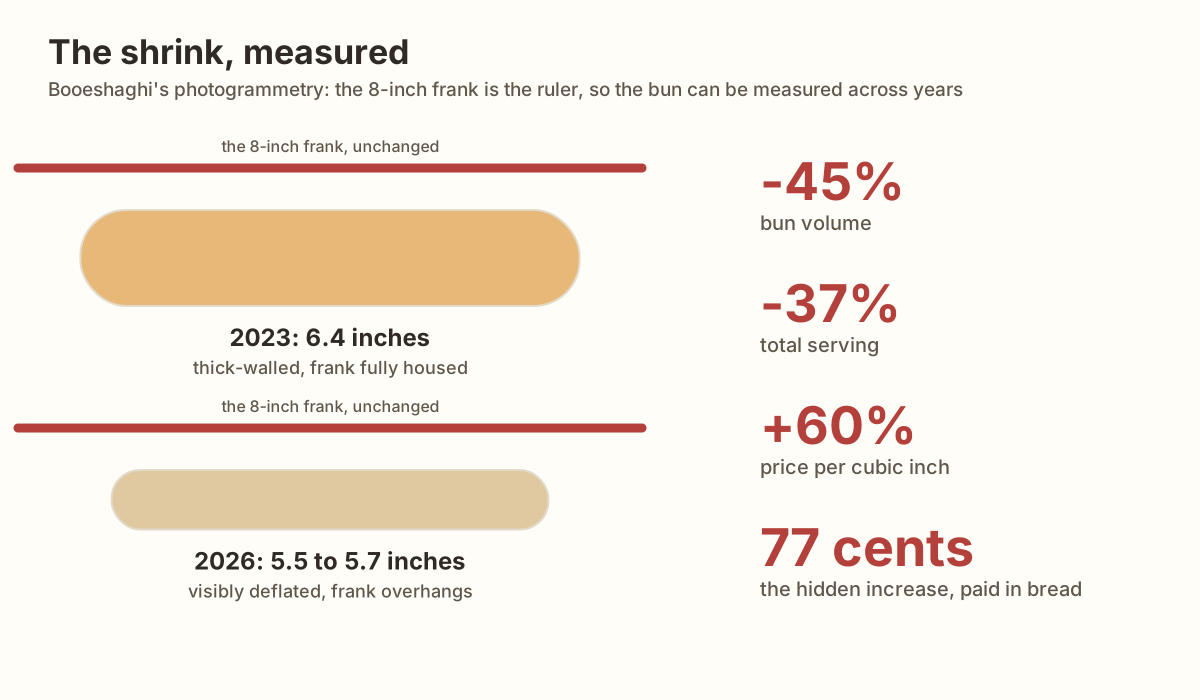
The members had been saying it with photos for a year before the math arrived. Exhibit A: a September 2025 thread titled "Anyone else outraged by Costco shortchanging the $1.50 Hot Dog bun-to-dog ratio?" with photographic evidence of frank overhanging bun in both directions. Exhibit B: the melancholy still life titled "Bottom bun from hot dog on Saturday", whose photo is the single best close-up of the naked food court bun on the public internet. Exhibit C: a June 2024 thread whose author offered the glass-half-full framing: "You can either look at it as not getting enough bun or getting extra dog."
The phenomenon is global. In May 2024, Taiwanese members noticed their dog no longer protruded past the bun and filed the same complaint in Mandarin; one commenter consoled the aggrieved by suggesting they fill up on soda refills instead. Costco, consistent with four decades of bun policy, has said nothing.
Part Nine: The Condiment Wars
No aspect of the hot dog generates more emotion per gram than the condiment station, whose history is a four-act drama of abundance, loss, agitation, and partial restoration.
Act one was the golden age. For decades the station was gloriously self-serve: pumps of ketchup and yellow mustard, a coarse deli mustard, sweet pickle relish, and the crown jewels, stainless steel crank-operated dispensers that dropped fresh diced onion, and at many locations sauerkraut, onto the dog. Grinding the onion crank was a small civic ritual. Julia Child, according to her biographer, was a food court regular whose order was two hot dogs with mustard and sauerkraut. The machines took abuse: employees recall customers snapping the cranks, and the freeloading was real. One employee's account: "I've seen customers order 2 hot dogs and ask for 8 sauerkrauts and then go fill their soda cups with onions to take home." A viral video from an Australian warehouse showed a woman doing exactly that from a locked dispenser, to which the internet's top comment replied that this was why nobody gets onions anymore.
Act two was the stripping. In 2020 the pandemic gave Costco cause to remove the shared-touch station, and the cranks never came back. Onions and sauerkraut vanished, the deli mustard pump disappeared, and the station shrank to ketchup, yellow mustard, and relish. Sauerkraut lingered longest as a behind-the-counter request item before fading out entirely somewhere between 2022 and 2023; the economist David Henderson, who tracked the decline in real time, marked its passing on Econlib as a case study in what he called a self-imposed price ceiling: "when inflation is present... a for-profit company that wants to keep a price constant will find ways of reducing its cost and, therefore, to most people, its value." His colleague Art Carden sharpened it with a line worthy of the genre: "Costco, after all, chose to stop offering sauerkraut and onions." Debauched currency, he argued, leads to debauched hot dogs.
Act three was the agitation: periodic Twitter eruptions over the missing onions, a Change.org petition demanding the dispensers' return, eulogies for the deli mustard ("Kraut and the spicy mustard. Both missed"), and one of the old crank dispensers surfacing at a thrift store priced at $75, described as vintage.
Act four is the slow, uneven restoration, and the dates matter because they are widely misreported. Diced onions returned first: after sightings in the Pacific Northwest, Costco confirmed on May 1, 2023 that "Diced Onions are returning soon," and the nationwide rollout landed May 8, 2023, under the internal code "P10 - W1." But they returned diminished, as small pre-portioned cups handed over at the counter, and fans complained about rationing ("it's been like 10 pieces") and afternoon shortages. Then, in October 2024, a member at the Riverton, Utah warehouse posted a photograph that briefly united the internet: an actual crank dispenser, restored, captioned with a meme reading "You're as beautiful as the day I lost you." ("Nature is healing," replied the crowd.) The deli mustard began quietly reappearing in early 2026, first spotted at the West Roseville, California grand opening and spreading through the spring; its brand has never been identified, and a food court manager was overheard discussing plans to get it its own label. Sauerkraut remains gone from American food courts, the last unhealed wound. Mexico's warehouses, meanwhile, have taunted the entire English-speaking internet throughout with their free, unlimited pickled jalapeño dispensers, and Japan's food courts never gave up the onion crank at all.
Part Ten: Costco Kimchi
The condiment station also produced the hot dog's greatest cross-cultural story, one with a rise, a crackdown, and an improbable second life.
The practice was first documented for Western readers by the Korean food blogger Joe McPherson in a 2011 ZenKimchi post titled "WTF: Korean Costco Banchan." Korean Costco members, he wrote, would "crank out a mound of chopped onions onto a plate," dress it with ketchup and mustard, and eat it straight, as a side dish, with whatever they had ordered: "One woman had a pizza in one hand and was eating the ketchup straight with a fork." The custom made perfect sense inside Korean food culture, where no proper meal lacks banchan, and a plate of sharp dressed onions slots neatly into the role kimchi normally plays against rich food. It is not kimchi in any technical sense; food writers have compared it more accurately to geotjeori, fresh unfermented kimchi. Shoppers offered their own defense to reporters: American food "tastes better when I eat the onions with the pizza or sandwiches. It's less greasy," said one. "It suits our taste, and onions are also very healthy for us," said another.
By 2017 the scale had become newsworthy. A Los Angeles Times report that September, relayed widely, found Korean warehouses going through roughly 200 tons of onions a year across the country's 13 stores, about 20 times the per-store consumption of American locations. The onion salad, the paper observed, "appears next to just about everything that's ordered in Costco, from pizzas to hotdogs and bulgogi rolls."
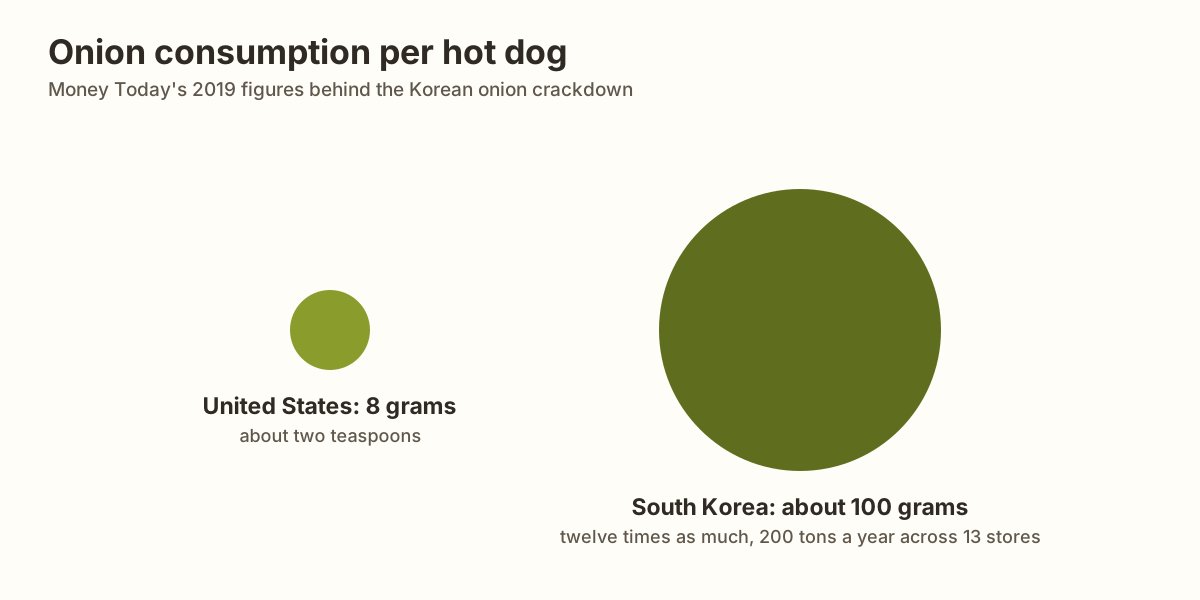
Then came the crackdown. In late November 2019, Costco Korea removed the self-serve onion dispensers from every food court in the country. The trigger was a phenomenon Korean media had dubbed "yangpa geoji," onion beggars: customers filling multiple plates, wrapping onions in foil brought from home, and carrying them out in cups and containers. The Korean outlet Money Today put numbers on it that deserve preservation: American customers used about 8 grams of onion per hot dog, roughly two teaspoons; Korean customers averaged around 100 grams, more than twelve times as much. Onions were thereafter dispensed as one small cup per hot dog purchased, under staff supervision. Korean reaction split between "It's good to reduce waste" and "Isn't it too stingy? We need onions for other items like pizza."
The second life came in 2025, when the practice boomeranged to the country that invented the condiment station. An American TikToker known as Photogami popularized a "Costco kimchi" recipe built entirely from food court supplies: two cups of diced onions, three pumps of ketchup, one pump of mustard, a spoon of relish, and two packets of crushed red pepper. "It's crunchy, a little bit spicy, salty... It kind of makes it like Korean-style quick kimchi," Photogami explained. The Korea Times covered the trend with visible amusement. Reddit's verdict: "It's not the real thing, but it scratches the itch." Forty years of condiment history, and the onions ended up where they started: rationed, beloved, and doing far more work than Costco ever intended.
Part Eleven: The Economics
The hot dog's finances are the subject of a long-running argument that Costco has carefully declined to settle, and the honest accounting runs like this.
Start with the revenue. At fiscal 2025's record 245.1 million combos, the hot dog brings in about $368 million a year, which sounds enormous and is not: against Costco's $275 billion in total revenue it rounds to 0.13 percent. Costco does not break out food court results; they disappear into an ancillary segment alongside gasoline and pharmacies.
Now the cost side, where the loss-leader debate lives. Before vertical integration, the combo genuinely lost money; that is the entire premise of the Jelinek-Sinegal exchange. After Tracy and Morris, the math changed. A Motley Fool analysis estimated the dog, bun, and condiments at 45 to 80 cents and the fountain soda at 10 to 20 cents, leaving daylight under $1.50 even at the high end, before labor and overhead. Jelinek himself said the quiet part in later years: "We keep it at $1.50 and make enough money to get a fair return." Galanti's formulation was more coy: "Needless to say we aren't making a lot or any" profit on the food court. The truthful synthesis is that the combo sits somewhere around breakeven at the unit level and is priceless at the brand level. As retail analyst Neil Saunders put it, the hot dog is "a symbol of what Costco stands for"; Forrester's Brendan Witcher was blunter, saying Costco is "buying customers' loyalty for whatever price they are unwilling to charge above $1.50." The real profit engine sits one counter over: membership fees, $5.3 billion in fiscal 2025, historically two thirds to three quarters of Costco's entire profit, with renewal rates above 90 percent. The hot dog is the cheapest possible daily advertisement for the card.
The Wall Street Journal, in a 2022 piece titled "The $1.50 Costco Hot Dog Combo That Defies Inflation," drew from Galanti the single best word in the whole discourse: the price is "sacrosanct." The corporate promise chronology bears it out. Jelinek, asked on CNBC in both 2012 and 2022 whether the price would rise, answered with one word: "No." Galanti, on the September 2022 earnings call, joked that "lightning just struck me" when the question came up, then committed to holding the price "a little longer... forever." His successor Gary Millerchip used his very first earnings call in May 2024 to declare, "To clear up some recent media speculation, I also want to confirm the $1.50 hot dog price is safe." CEO Ron Vachris escalated to video in March 2026, doing the viral price-reaction trend at a food court counter and stating flatly: "The hot dog price will not change as long as I'm around."
The price pledge, explained. Video: VinePair, YouTube.
The market has tested the price's cultural load exactly once. On May 18, 2022, a parody account called @JohnWRichKid, whose bio identified its owner as a Wendy's fry cook, tweeted a fake breaking-news alert that Costco would raise the combo by a dollar. Costco's stock fell about 12 percent that day, roughly $27 billion in market value, and the House Republicans' official account amplified the fake with an inflation hashtag before deleting. The debunking belongs next to the legend: it was a brutal week for all retail stocks, with Target down 25 percent on earnings, so the tweet's causal role is, as analyst Trung Phan put it in his autopsy, "probably a stretch." But the fact that the story was instantly believable is the point.
Competitors noticed. In November 2022, Sam's Club cut its own combo, a quarter-pound dog with a 30-ounce drink, from $1.50 to $1.38, announced with the tagline "New lower price. Same great hot dog & drink combo. Frankly, it can't be beat," and pushed by Walmart's CEO personally. Bloomberg later reported the cut boosted sales enough to lift profits and framed it as the opening salvo in a value war. Costco did not respond, which was the response. In shopper taste tests the twelve cents bought nothing: "the $0.12 difference isn't really a consideration," as one put it, and Costco's frank measures over a quarter pound while Sam's Club's comes in under.
The soda has its own economic history. Costco pulled Coca-Cola off warehouse shelves in a 2009 wholesale pricing fight, a separate skirmish often conflated with the food court story. The fountains switched from Coke to Pepsi in 2013 purely on price, in explicit service of the $1.50. Twelve years later the flow reversed: Vachris announced at the January 2025 shareholder meeting, in answer to a member's question, "This summer we will be converting our food-court fountain business back over to Coca-Cola." Along the way the standalone soda quietly rose from 59 to 69 cents while the combo held. And in April 2026 came the first structural change in the combo's history: members may now swap the 20-ounce soda for a 16.9-ounce Kirkland bottled water, still $1.50, a trade reviewers immediately identified as the worst deal in the food court.
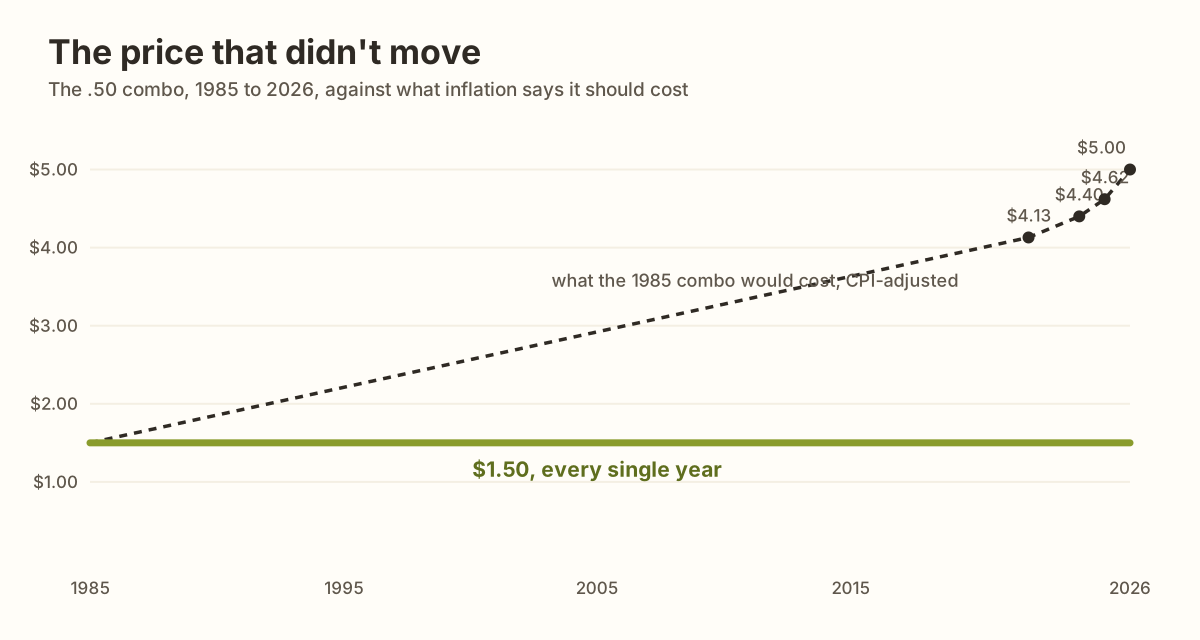
Every inflation calculation ends at the same punchline. Depending on the publication date, the 1985 combo "should" cost $4.13 (2022), $4.40 (2024), $4.62 (2025), or about $5 (2026). The number keeps drifting up. The price does not.
Part Twelve: The Numbers
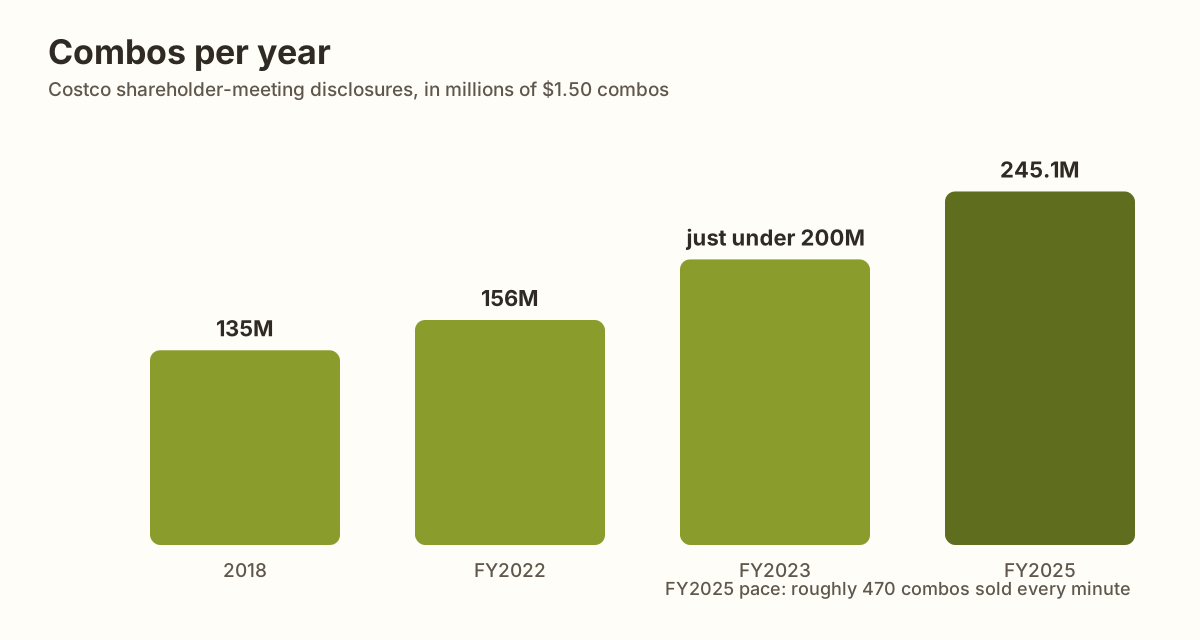
The volume trajectory, drawn from Costco's own shareholder meeting disclosures where possible: about 135 million combos in 2018, 156 million in fiscal 2022, just under 200 million in fiscal 2023 (Vachris, having publicly targeted 200 million: "We came up a little short... but I can assure you we're all going to work hard"), and a record 245.1 million in fiscal 2025. That is roughly 470 combos sold every minute of the year.
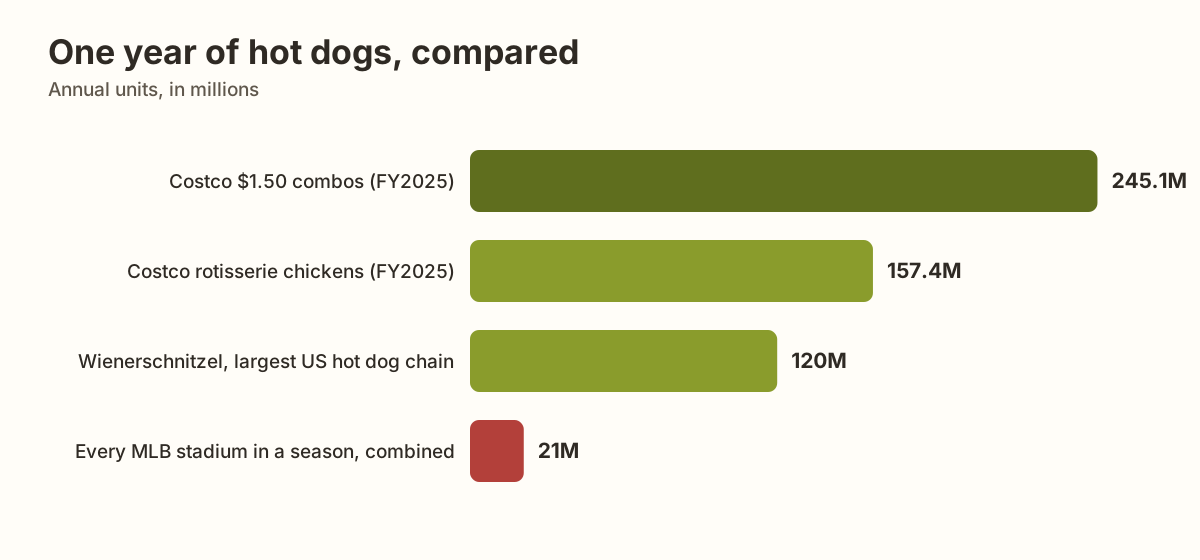
The comparisons are where the scale lands. The National Hot Dog and Sausage Council counted about 19 to 22 million hot dogs eaten across all Major League Baseball stadiums in a season; Costco sells roughly ten times that. Wienerschnitzel, the largest hot dog chain in America, sells about 120 million a year; Costco beats it by a hundred million. The combo outsells Costco's other sacred fixed-price item, the $4.99 rotisserie chicken, which moved 157.4 million units in fiscal 2025. And the hot dog is not even the food court's busiest day-maker: the single-day record belongs to Halloween, when Costco sold 358,000 whole pizzas in one day, and a food court employee confirmed the calendar: "Halloween happens to be the busiest day of the year. Busier than superbowl."
Part Thirteen: The Hot Dog Abroad
The combo operates in every Costco market on earth, adapted in ways that amount to a small atlas of food culture.
Canada has the cheapest Costco hot dog in the world: CAD $1.50, about $1.06 American, and Canadian food courts still serve the Polish sausage the United States lost in 2018, a fact Canadian media report with unconcealed satisfaction. Japan is nearly as cheap at 180 yen, tax included, and serves a 100 percent pork frank in a roughly 20-centimeter bun, photographed lovingly by the Japanese food site Macaroni, with the dog protruding proudly past the bread. Taiwan's dog has held at NT$50 for 27 years, and its bun has its own drama: in August 2021 members noticed their smooth sesame-topped roll replaced by a dusted, seedless, McMuffin-textured one and fought about it in the press, with Costco Taiwan's official Facebook later framing it as adopting the American cornbread-style recipe; in 2025 Taiwanese netizens discovered Japan's dog was effectively cheaper and were, in the local press's word, furious. South Korea sells the combo for 2,000 won alongside bulgogi pizza and abalone porridge. China's warehouses price it at 10.9 yuan with a pork frank and a seafood pizza on the menu; the 2019 Shanghai opening drew crowds so large the store closed early on day one.
Mexico prices the combo around 35 to 41 pesos and supplements it with the jalapeño dispenser of American dreams, documented as far back as a 2010 Creative Commons photo from the Ensenada warehouse. The United Kingdom charges £1.50 and serves jacket potatoes at the next register, a sentence that could only be written about Britain. France charges €1.50 with a distinctly French complication: since 2019 it has been illegal to offer free refills of sweetened drinks in France, so French Costco cups carry QR-code stickers that meter exactly one fill. Sweden's single warehouse serves its dog with crispy fried onions in the national style.
And then there is Iceland, the most expensive Costco hot dog on earth at 299 krona, about $2.15, and the best story. When Costco opened its only Icelandic warehouse in May 2017 outside Reykjavík, the crowds were so large that search and rescue teams were deployed for traffic control; within a year, 71 percent of Icelandic households held a membership, in a country with no McDonald's and no Starbucks. Iceland is arguably the most hot-dog-proud nation on the planet, home of Bæjarins Beztu Pylsur, the 1937 Reykjavík stand where Bill Clinton famously ordered a lamb-blend dog with mustard only. The national stand's dog now runs 880 krona. Costco's combo, with a drink, costs a third of that. The pylsur partisans keep the faith on quality. The wallet math speaks Kirkland.
Part Fourteen: What People Actually Think
Consumer opinion on the Costco hot dog is overwhelmingly positive, but the record is more textured, and more fun, than the legend suggests.
Start with the heresy: in the only substantial head-to-head poll found, the hot dog lost. Mashed surveyed 609 American Costco shoppers in 2022 on the best food court item, and pizza won, 34 percent to the hot dog's 27.6. A companion survey on discontinued items produced a second heresy: shoppers most wanted back the barbecue brisket sandwich, with the Polish dog second. The hot dog is the food court's icon; it is not unanimously its favorite.
Against other warehouse clubs, though, the verdict is lopsided. In a four-way comparison, Costco took first, Sam's Club second despite the lower price ("In every other way, Costco's hot dog is superior"), BJ's third with reviews invoking chemical and fishy notes, and Ikea's dollar dog last, with one regular calling it "the cheapest and least tasty hot dog that I regularly eat."
Serious food media has weighed in with qualified love. Uproxx's taste test against a gourmet Olympia Provisions frankfurter found the Costco dog had "a mild snap, it's meaty, and it's moist... almost zero mealiness," but flagged the defining flaw: "very salty," redeemed when spicy mustard and pickle cut through. The sodium criticism recurs everywhere serious: an Eat This, Not That panel ranked the retail Kirkland franks dead last among seven store brands ("Super salty!"), and nutritionists cite the combo's 1,750 milligrams of sodium with alarm. The other dissent is the absence of char, which is structural: a water-bathed dog will never have a grill line, and people who miss one are describing a different hot dog on purpose.
The fullest appreciation came in July 2026, when The Ringer published "America's Greatest Hot Dog," calling the combo "the last great deal in America" and collecting a chorus: Simpsons writer Bill Oakley ("What's not to like? I mean, it's the archetypal hot dog"), podcaster Nick Wiger ("It's so good, it's hard to even call it fast food"), and Jamie Loftus, author of a book-length hot dog odyssey, with the definitive backhanded rave: "It costs $1.50, and it doesn't taste like nuclear waste." Bob Collins supplied the company's own theology: "The food court really isn't ours. It's our members'." And wherever Costco operates, he added, the hot dog is "the no. 1 item... by a long shot."
Part of what people taste, of course, is the price. A behavioral economist would tell you that the last ingredient in the recipe is the $1.50 itself.
Part Fifteen: The Culture
Somewhere in the 2010s the hot dog crossed over from good deal to folk institution, and the milestones can now be dated like a saint's calendar, with Know Your Meme maintaining the official subculture file.
The meme era opens in January 2014 with a viral tweet about the never-changing price. The founder mythology went mainstream on September 20, 2020, when the account @weirdcities posted screenshots of a Mental Floss article containing Sinegal's kill threat, collecting nearly ten thousand likes in a day; an April 2022 Reddit repost drew fifteen thousand more. February 2024 delivered the reverence genre's exemplar, "imagine eating a Costco hotdog here," posted over a sublime landscape, 114,000 likes. The price's role as folk economic indicator hardened during the 2022 inflation surge, when the combo was invoked everywhere as the one number in America that refused to move, alongside its only true peer, the 99-cent AriZona iced tea. There is a memecoin called the Costco Hot Dog Index. There is a genre of TikTok captioned "proud to announce I paid off my Costco hotdog."
The merchandise came next: a print shop's t-shirt of the Sinegal quote styled as a food court menu sign went viral in 2023 and sold hundreds of units at $22.95, which the shop helpfully noted was fifteen combos. A Washington-area man had the combo tattooed on his arm. Couples have married at Costco food courts, including one pair who wed at the counter where they had their first date. A Bay Area chef began 3D-printing a $19.69 clip-on cart tray called the Buck Fifty, engineered to hold a combo on the shopping cart's top rack; it took 600 preorders in weeks.
The food hacks form their own folk cuisine: the "forbidden glizzy," a hot dog stuffed into a chicken bake; the "jochizza," which adds cheese peeled from a pizza slice; the croissant dog, built from a bakery-aisle croissant ("I don't think this is legal," offered one commenter); and the pizza-cheese cheese dog, summarized by its chronicler in the spirit of the whole genre: "Who needs a bun?"
Celebrity attaches to the dog at every altitude. Julia Child's standing order has already been entered into the record. Kim Kardashian sang about the food court in a cut-for-time SNL sketch in 2021. A YouTuber named Joey Kinsley, known as Sir Yacht, ate nothing but the combo for a week in January 2024, 29 hot dogs for $43.50 total, and reported, "My stomach is an absolute f---ing warzone right now." The TikTok father-and-son act A.J. and Big Justice, the Costco Guys, turned food court reviews delivered in booms out of five into a media empire: a Billboard-charting single, a Tonight Show appearance, and an actual professional wrestling run, with A.J. winning matches in AEW as Big Boom A.J. In March 2026, Rare Character Whiskey released a Costco-exclusive bourbon named "I Got That Dog in Me," 126.1 proof at $85.99, its label a portrait of the combo; it sold out by the next morning, ignited a Washington DC whiskey hunt, and hit four-figure resale prices, while Reddit tasters solemnly reported subtle notes of hot dog water.
Even politics cannot leave it alone. The House GOP amplified the fake price-hike tweet. An American Prospect essay coined the "hot dog guy problem" to describe economics commentary that praises the $1.50 miracle while ignoring the prices rising around it, an argument built, fittingly, on a Tim Robinson sketch about a man in a hot dog suit. And in October 2024, a sitting vice presidential nominee attended a $250,000-a-ticket fundraiser at the home of Jim Sinegal, the man who once threatened murder over a quarter. The hot dog was not on the menu of record. It did not need to be.
Since 2024, incidentally, you need a membership card to buy one: signs went up that spring announcing that food court purchases require an active membership, closing the era of the walk-in combo. It made national business news on CBS, CNBC, and Fox, which tells you what category of object this hot dog now is.
Part Sixteen: Why It Endures
Strip away the lore and the mechanism is visible. A fixed price on a beloved product is a promise, and promises compound. Costco spent real capital to keep this one: two federally inspected meat plants, a soda contract flipped twice, a frank enlarged rather than shrunk, four decades of executives ritually renewing the vow like a liturgical calendar. In exchange it gets the cheapest and most credible advertising in American retail, a daily proof, sold a quarter of a billion times a year, that the membership card means what it says. The economists are right that the sauerkraut was a real price increase, and the bun really did shrink, and somebody in Issaquah knows to the tenth of a cent what the promise costs. The customers are also right that a juicy quarter-pound-plus all-beef hot dog with a bottomless soda for a dollar fifty in 2026 is, by any sane accounting, an anomaly bordering on a gift.
One half of the combo is a monument; the other half is a marketplace. Sinegal's explanation still cannot be improved upon: everybody talks about it. We're known for that hot dog. That's something you don't mess with.
The Exhibits: A Visual Evidence File
All links verified August 2026. The Flickr photo is CC licensed (BY-NC-ND, credit Bill Gracey); the Booeshaghi figure is a personal blog's original work; everything else should be linked or embedded via platform tools rather than copied.
- The four-panel bun measurement figure from Booeshaghi's shrinkflation study: 2023 vs 2026 photos scaled against the 8-inch frank, with traced bun outlines. The core visual of the shrink story.
- The naked bottom bun, from "Bottom bun from hot dog on Saturday" (Sept 2025). Best close-up of the bun alone on the public internet.
- Bun-to-dog ratio evidence from the "outraged" thread (Sept 2025).
- The Riverton, Utah onion crank restoration photo from the 2,600-upvote thread "The onion grinder is back!" (Oct 2024).
- Francisco Gourmet Seeded Hot Dog Rolls packshot and price history, the West Coast food court bun at retail; official listing.
- S. Rosen's Mary Ann buns packshot, the Midwest bun at retail.
- Engelman's own product photography of its challah and potato rolls, plus the smoking-gun Instacart listing named "Costco Food Court Hot Dog Bun".
- The Ringer's original photography (hero close-up by Conal Deeney), the best professional shot of the assembled dog.
- Macaroni's photo tour of the Japan food court dog: wrapped dog, topping station, finished product, bun clearly visible.
- The Ensenada, Mexico jalapeño dog, 2010, Creative Commons, the oldest clearly licensed Costco hot dog photo found.
- The pizza-cheese bun-replacement photos at The Takeout, for the hacks section.
- China Times' photo of Taiwan's changed bun (Aug 2021).
Corrections Desk
In the interest of not becoming part of the misinformation this post catalogs. The origin is dual: Price Club sold the first $1.50 combo from surplus 1984 Olympics carts in San Diego, while Costco's own program began with an unauthorized vendor in Portland in 1985; most accounts merge the two, and anniversary math runs from 1985. The switch to Kirkland franks is variously dated 2008 (development), 2009 (rollout, best supported by Costco's own magazine), and 2011 (the Tracy line, per Wikipedia). The California plant is in Tracy, not Los Angeles, despite executive shorthand. Sam's Club's cut came in November 2022. The onions returned nationally on May 8, 2023; the deli mustard began returning in 2026; the bourbon launched in March 2026 at $85.99. Costco has never confirmed any bun supplier, rationale, or spec; the supplier map rests on employee statements, retail matching, and one gloriously literal Instacart product name. Engelman's founding year is given as 1983 by the company and 1982 by its acquirer. Taiwan's bun switch is documented in August 2021 press coverage while Costco Taiwan's social media dates the American recipe to 2022; both may be true in sequence. The claim of a "Costco Kimchi" YouTube documentary circulates but could not be located. And the single poll in which pizza beat the hot dog is real, and Costco loyalists will simply have to live with it.


