


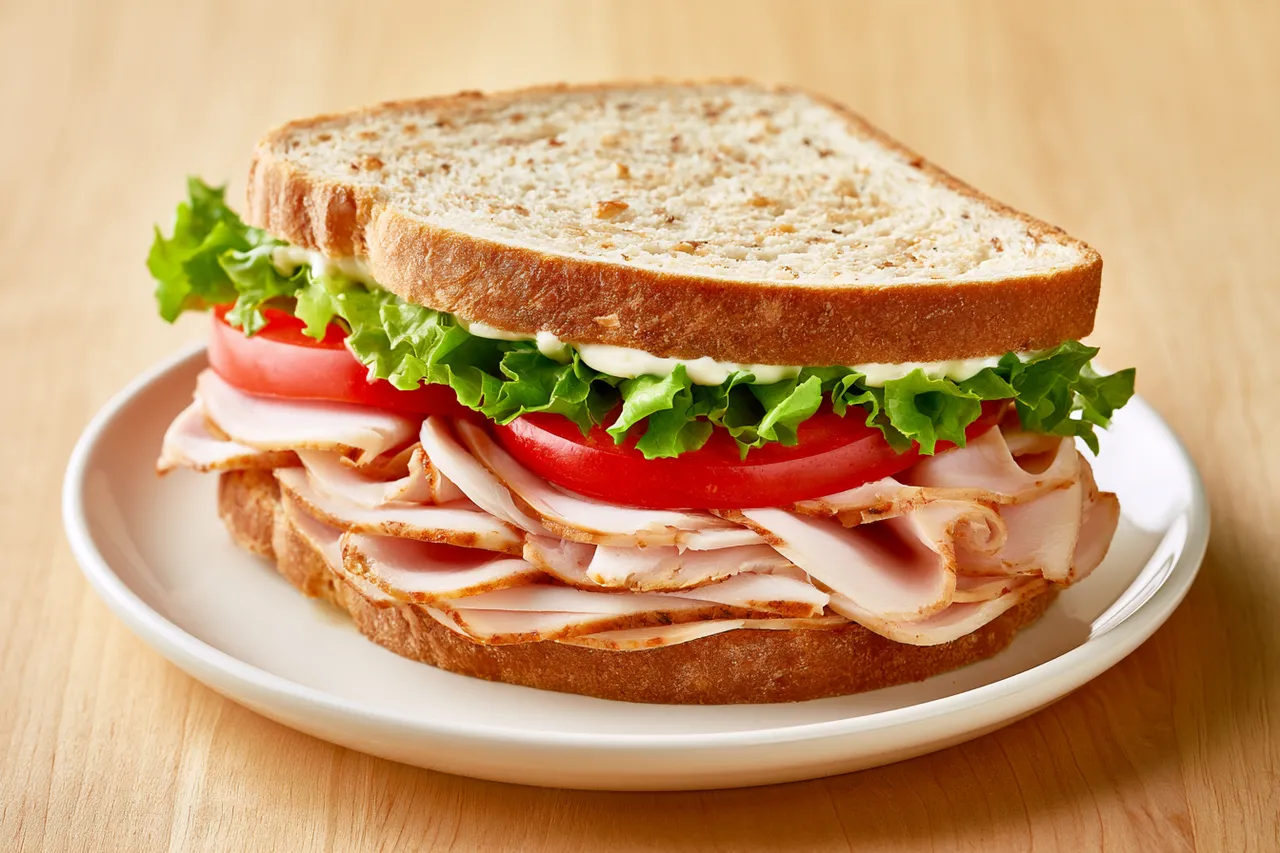
Stack turkey, cheddar, mayonnaise and tomato on white bread in the builder and it shows 64. Add kimchi and it shows 84. That sandwich is the running example throughout.
We describe each rule by its direction and shape: which things count for more, which count for less, and where the sharp steps are. We do not print the weights or the thresholds.
1. What the builder knows about an ingredient
The pantry holds 411 ingredients: 87 proteins, 83 sauces and condiments, 70 cheeses, 52 vegetables, 42 breads, and smaller groups of herbs, fruits, acids and fats. Each one carries the same record.
- Seven flavor numbers from 0 to 5: salt, acid, fat, sweet, umami, heat and bitter.
- A role, which sets how much the ingredient counts when the builder averages a sandwich. A protein, a fat or an acid counts in full. Bread counts about half. A garnish barely counts.
- Texture tags such as crispy, creamy, juicy, melty or pickled.
- A quality tier: Low, Medium or High. Medium is the default.
The builder averages the seven numbers across the stack, by role and amount, to get the sandwich's flavor profile. Everything about seasoning is judged from that profile.
2. The eight pillars
The builder asks eight questions of every sandwich and answers each on a scale from empty to perfect. We call them pillars.
| Pillar | The question | Weight |
|---|---|---|
| Balance | Is it seasoned? Salt, acid and fat each in a comfortable range, with umami, a little heat and something fresh. | Most |
| Harmony | Do the layers belong together? Every pair of ingredients is looked up. | Most |
| Contrast | Is there something crisp against something soft, and acid to cut the fat? | Middle |
| Structure | Is it a whole sandwich? Bread, a main layer, a fat, an acid, and a sensible amount of filling. | Middle |
| Focus | Is there one lead? Three unrelated meats and five loud flavors is a crowd. | Middle |
| Composition | Is it a finished piece? A recognized form, or layers that all pair and fill the roles. | Most |
| Envelope | Does its flavor sit inside the range of real sandwiches in our catalog? | Least |
| Quality | What is it made of? The tier of the bread and the lead ingredient. | Middle |
Balance
Salt, acid and fat each have a comfortable range. Inside it the sandwich earns full credit. Below it the sandwich is underseasoned, and above it the credit falls away.
The three are combined so that one badly missed range cannot be covered by two good ones. Umami, a tolerable level of heat and a fresh or herbal layer add smaller amounts. Balance then takes a deduction for richness without relief. One rich layer owes nothing. Three rich layers with no acid, no fresh leaves and nothing bitter to cut them lose most of the pillar.
Sweet sandwiches use different ranges. The builder decides sweet or savory by what leads the build: jam, honey, fruit or chocolate on one side, anything salty, savory or hot on the other.
Harmony
Harmony looks up every pair of ingredients in the stack. A pair can be related in three ways.
- A named pair. We wrote 1,211 of these by hand, each with a short note, in three grades. 160 are iconic (corned beef and sauerkraut), 758 are solid and 293 are customary (turkey and mayonnaise).
- A pair the catalog uses often. 565 pairs were mined from how often two ingredients appear together across the site's sandwiches.
- A complement by the numbers, such as a fat beside an acid.
Each layer is judged by its best partner, and Harmony is the average across layers. A loud ingredient with no partner at all counts as a wrong note.
Contrast
Mostly this is something crisp against something soft, and acid to cut the richest layer. Variety of textures, a share of fresh vegetable and a counterpoint such as sweet against salt add smaller amounts. Toasting or pressing the bread counts as crispness.
Structure
Half of Structure is coverage: bread, a main layer, a fat and an acid. The other half is the amount of filling. It rises quickly with the first layers and falls once the sandwich is overloaded.
Focus
A sandwich should have a lead. Focus looks at how the meat is divided (three unrelated meats in equal parts is a sampler), how many layers are at full volume on some flavor, and how many layers there are. Meats that belong together count as one family, so the salami, capicola and ham of an Italian sub are a single lead.
Composition
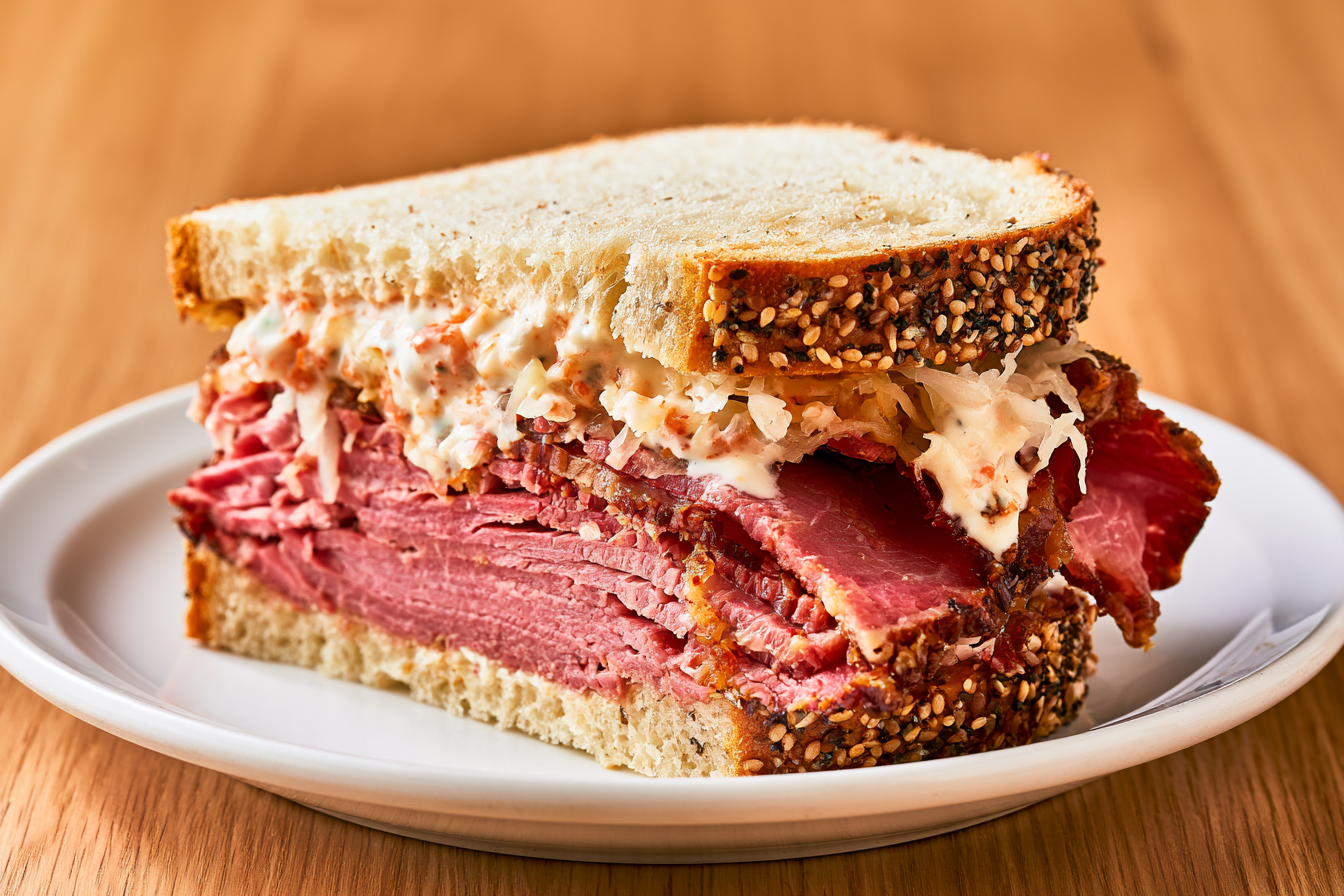
Any complete sandwich can satisfy the other pillars. Composition asks whether this one is a finished piece. The largest part is form. The builder knows 58 traditional forms, each defined by its required parts: a Reuben is rye, corned beef, sauerkraut, Swiss and Russian dressing. A missing part costs more than its share. A sandwich with no tradition behind it can earn form through coherence, if every layer has a strong partner and the roles are filled in a small number of layers.
A fully realized form also carries a contract. An egg salad sandwich is soft on purpose, so a complete one is excused part of its Contrast shortfall.
Envelope and Quality
Envelope checks that each flavor average falls inside the range most of the catalog occupies. Quality reads the tier of the bread and the lead ingredient, with the lead counting for more. Other layers can pull Quality down a little and can never raise it, so a sandwich cannot garnish its way up a tier.
3. From eight answers to one number
The builder does not average the pillars. It measures how far each one falls short of perfect and charges for the shortfall on a rising curve.
Each charge is scaled by the pillar's weight and the results are added. The weakest pillar is then charged a second time, so a sandwich that is fine on seven pillars cannot hide a wreck on the eighth.
4. The curve that turns shortfall into a score
The total charge goes through an S-shaped curve to become a score. The curve is steepest for rough builds, so the first sensible additions to a bare sandwich are worth the most. Near the top the same improvement is worth a few points. We fitted the curve to 183 hand-graded sandwiches, described in section 9.
5. Penalties, gates and the ceiling
Some faults are events more than shortfalls. The builder names them and subtracts points. From largest to smallest:
- Condiments only, with no solid filling. This is the largest single deduction.
- A named clash between two ingredients, such as fish with a sweet spread.
- Sauce overload. It grows with each sauce doing the same job.
- Too hot, when the build is hotter than nearly everything in the catalog and heat is not the point of its form.
- Bitterness takes over, or the build is too salty.
- A wet layer on soft, untoasted bread.
- Too many doubled portions, and pressing a sandwich with crisp fresh layers. These are the smallest.
The running example has tomato against soft white bread, so it takes the wet-layer deduction.
A score of 90 or more has extra conditions. Seven of the pillars have a gate, a level the pillar must reach. If any gate fails, or any penalty applies, the score cannot pass 89. The sandwich also needs at least one layer marked High. A Reuben built from Medium ingredients shows 89. Mark the corned beef High and it shows 94.
6. Two walkthroughs
Building up
Piling on
More ingredients do not raise the score on their own. The ham, salami and beef each bring pairs, but they split the lead three ways, and the later layers cost Structure and bring a sauce deduction.
The suggestions are real rescores
For every suggestion the builder makes each legal single change (add an ingredient, change an amount, remove a layer, change the preparation), rescores the whole sandwich, and reports the true difference. For the running example it tried 379 changes.
| Change | Its reason | Points |
|---|---|---|
| Add kimchi | kimchi under melted cheddar | +20 |
| Add lettuce | the last missing piece of a classic turkey sandwich | +19 |
| Serve it pressed | clears "a wet layer on soft bread" | +16 |
For longer plans it looks a few moves ahead and only adds ingredients that have a real relationship with something already in the sandwich. Its plan here is kimchi, then apple butter, which finishes at 89.
7. How it handles real builds
We ran about forty builds picked to test one thing each: nearly empty ones, famous sandwiches with two ingredients, deliberate mistakes, and pairs that differ in one thing only. The scores below are what the live engine returns.
Almost nothing
| Build | Score | What happens |
|---|---|---|
| Bread alone | 34 | Every pillar except Envelope and Quality is weak. Two slices of bread land at the top of the chaos band. Nothing is actively wrong, and nothing is there to score. |
| Condiments only | 18 | Mayonnaise, mustard and ketchup with nothing solid. The largest deduction applies and the build lands in chaos. |
| Five sauces on turkey | 35 | Turkey under mayonnaise, mustard, ketchup, Russian dressing and hot sauce. The sauce deduction scales with the count. |
Famous sandwiches with almost nothing in them
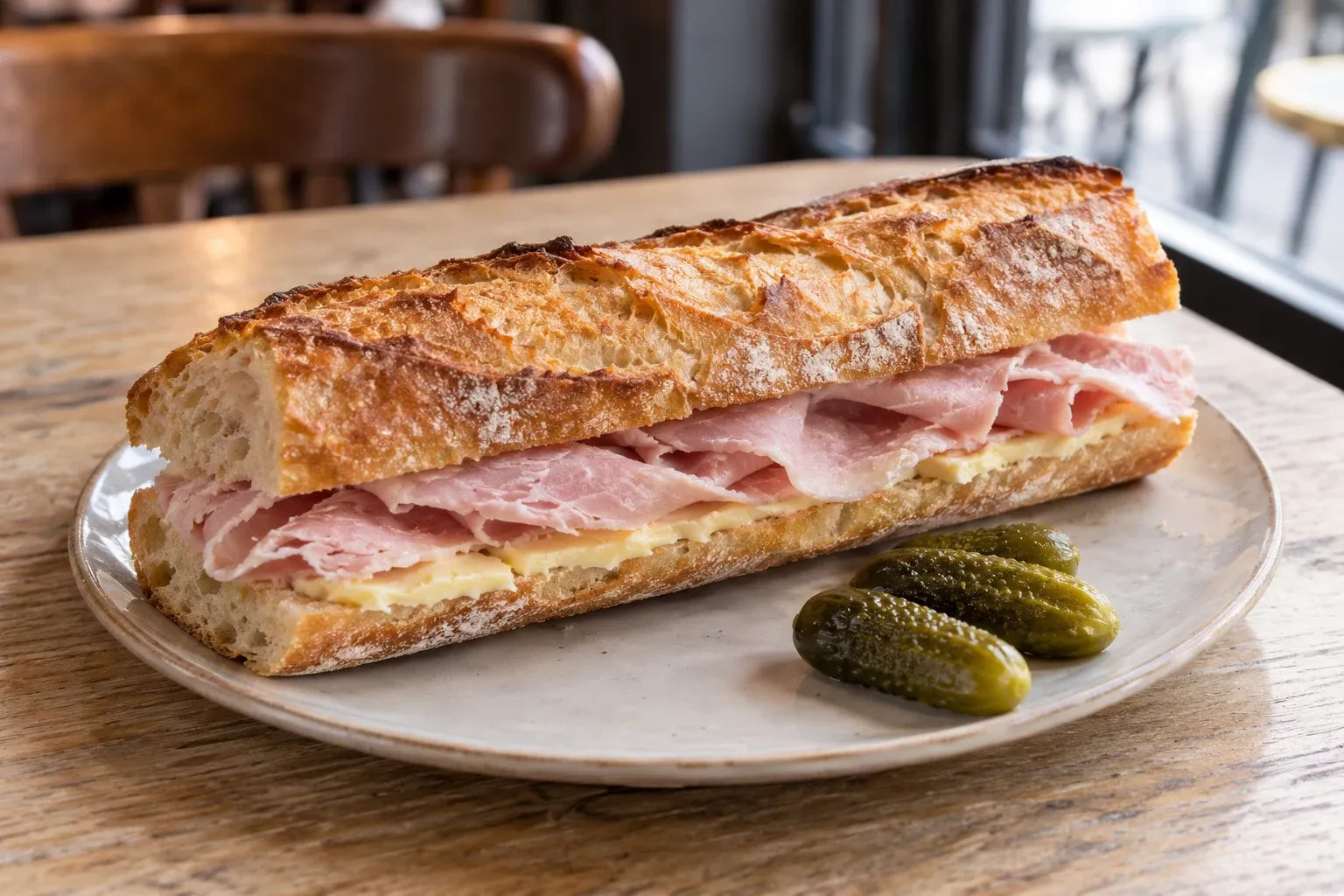
Several of the best sandwiches in the world have two or three ingredients. The builder knows them as forms, and a recognized classic is excused what it leaves out on purpose.
| Build | Score | What happens |
|---|---|---|
| Cheese on bread, cold | 45 | Cheese on cold bread. No form, no crispness, no fat beyond the cheese. |
| Grilled cheese | 51 | Pressing adds crispness and melts the cheese. Still not a grilled cheese, because the form needs its butter. |
| Grilled cheese with butter | 74 | With butter the form is complete and the score rises 23 points. Completing a form is one of the largest single steps in the method. |
| Jambon-beurre | 82 | Recognized as a complete jambon-beurre, so it is excused the acid and the extra layers it leaves out on purpose. The same ham and butter on white bread is no form at all and scores 51. |
Bread and preparation
The same four fillings score differently by bread. The builder reads the bread's texture, and a crusty loaf supplies the crispness that a soft one lacks.
| Build | Score | What happens |
|---|---|---|
| On white bread, cold | 64 | The running example on white bread, cold. Takes the wet-layer deduction. |
| On sourdough, cold | 85 | 21 points higher. The crust supplies contrast, there is no wet-layer deduction, and no gate fails. |
| In a flour tortilla | 66 | A wrap is exempt from the wet-layer deduction and gains nothing else. |
| Tomato and mozzarella on white, cold | 79 | Tomato, mozzarella and basil on white bread. Recognized as a caprese. Only the Contrast gate fails. |
| Same, toasted | 89 | Toasting clears the Contrast gate and the build reaches the ceiling. |
| Turkey, cheddar, lettuce, tomato, toasted | 89 | Turkey, cheddar, lettuce and tomato on toasted sourdough. |
| The same, pressed | 86 | Pressing the same sandwich wilts the lettuce and takes a small deduction. |
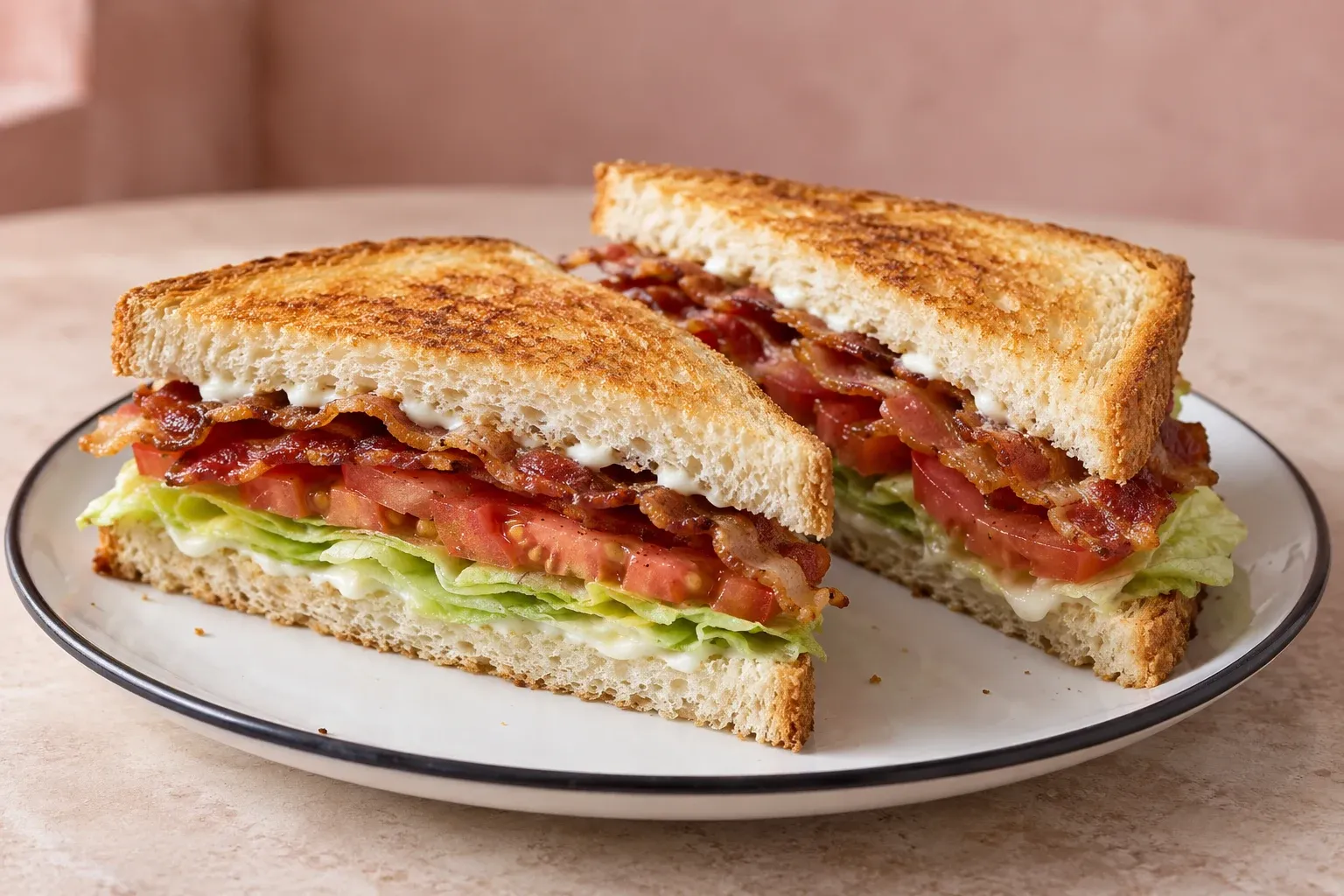
Toasting the running example on white bread takes it from 64 to 81. Toasting a Reuben or a BLT changes nothing, because both are already at the ceiling.
Too much
| Build | Score | What happens |
|---|---|---|
| Reuben | 89 | The complete form. No gate fails. |
| Reuben plus turkey, ham, bacon | 84 | Add turkey, ham and bacon and it loses 5 points and its form. Three more meats bring pairs but split the lead. |
| Three doubled layers | 79 | Double turkey, double cheddar and double mayonnaise on sourdough. 6 points below the same build in regular amounts. |
Portions count too. On a toasted white-bread BLT, which scores 89, doubling the bacon costs 11 points, a light hand with the bacon costs 4, and doubling the mayonnaise costs 5. A portion registers when it pushes the flavor profile out of a comfortable range.
Sweet, savory, and the line between them

| Build | Score | What happens |
|---|---|---|
| Peanut butter and jam | 76 | Judged as a sweet sandwich, with sweet ranges for salt, acid and fat. A completed form. |
| Peanut butter, jam, kimchi | 66 | Still judged as a sweet sandwich, because the peanut butter and jam outweigh the kimchi. It loses points for the wet layer, and the salt in the kimchi pulls Balance down. |
| Peanut butter, banana, bacon | 78 | Peanut butter, banana and bacon, pressed. Stays sweet with bacon in it, because the form is known. |
| Peanut butter and bacon | 59 | Take the banana out of the same pressed sandwich and it loses 19 points. It is still judged as a sweet sandwich, but the form is incomplete and nothing fresh or soft is left to set against the bacon. |
| Tuna and jam | 34 | A named clash: fish with a sweet spread. |
| Banana, peanut butter, sauerkraut | 45 | Peanut butter, banana and sauerkraut. A named clash, plus the wet layer. Harmony falls below its floor. |
Extremes of flavor
| Build | Score | What happens |
|---|---|---|
| Four hot layers on chicken | 60 | Hot sauce, sriracha, pickled jalapeño and cayenne on chicken. Recognized as hot chicken, so the heat deduction is waived. |
| Anchovy, prosciutto, feta, olive | 54 | Anchovy, prosciutto, feta and olive. The salt deduction applies and Balance falls out of range. |
| Broccoli rabe and vegemite | 41 | Broccoli rabe and Vegemite on sourdough. No named deduction fires. The pillars alone put it in the rough band. |
| Hummus, cucumber, tomato, red onion in pita | 75 | Hummus, cucumber, tomato and onion in pita. No protein and no form. It reaches very good on pairing and freshness, which shows the method does not require meat. |
Quality tiers
| Build | Score | What happens |
|---|---|---|
| Reuben, Low corned beef | 80 | Low corned beef. The Quality gate fails. |
| Reuben | 89 | Medium corned beef. At the ceiling. |
| Reuben, High corned beef | 94 | High corned beef. The only way past 89. |
The tier is whatever the person building says it is. Catalog entries carry no tiers, so the catalog tops out at 89.
8. What the score guarantees
A rubric is a function from a thing to a number. Before asking whether the numbers are right, it is worth asking what properties the function has.
| Property | What we found | Verdict |
|---|---|---|
| Bounded and deterministic | Scores stay between 0 and 100. The same build returns the same score every time: we ran one build 50 times and got one answer. | Holds |
| Does not reward volume | Adding layers stops helping and then hurts. The pile-on peaks at 64 and falls to 48. | Holds |
| Weakest link counts | A large shortfall costs more than its share and the weakest pillar is charged twice. Seven good pillars do not buy back a bad one. | Holds |
| Small changes, small moves | Across 2,976 random single additions to random three-layer builds, the median change was 2.8 points and nine in ten were under 8.8. The larger steps come from a named deduction or a completed form, and the builder says which. | Holds |
| Responds to portion | Doubling the bacon on a BLT costs 11 points and a light hand costs 4. | Holds |
Two limits are choices. A score of 90 requires an ingredient someone has vouched for, so the catalog tops out at 89. Layer order is not scored, because a builder that asks people to arrange twelve layers is a worse builder.
9. Against a critic's grades
A critic reviewing a sandwich looks at the bread, the ratio of filling to bread, seasoning, texture, temperature, whether the thing hangs together, and the quality of what went into it. Each of those has a place in the method.
| What a critic checks | Where the builder looks |
|---|---|
| Seasoning | Balance, from the flavor numbers of each layer |
| Whether it hangs together | Harmony and Composition, from named pairs and known forms |
| Texture | Contrast, from texture tags and the preparation |
| Restraint | Focus and Structure |
| The bread | The kind of bread and its tier |
| Quality of ingredients | The tier of the bread and the lead ingredient |
| Ratio of filling to bread | A count of layers and three portion sizes |
| Temperature | Cold, toasted or pressed |
Execution is outside its reach. The builder scores a recipe, and a cook can still ruin it.
We have one critic's grades to test against. Andrew graded 183 sandwiches from the menus of 47 shops as high, medium or low (68, 61 and 54).
Take any sandwich he graded higher and any he graded lower. The builder puts the pair in the right order 80.1% of the time, across 11,114 such pairs.
Where the two differ, the builder leans toward completeness and Andrew's grades lean toward distinction. A sandwich that fills every role can be ordinary, and a sandwich with three ingredients can be the best thing on the menu. That is why the forms matter: each one teaches the builder a sandwich that is finished with very little in it.
10. As a game
People who train game-playing programs test the scoring rule as carefully as the player, because a program will do whatever earns points. So we treated the builder as a game, with the score as the reward, and asked what a benchmark designer would ask.
Three players
We compared three ways of producing sandwiches. A random policy picks a bread, a preparation and two to six fillings by chance (3,000 builds). The catalog is 4,499 sandwiches people actually make. A greedy agent starts from a random bread with one to three random fillings and takes the builder's own top suggestion, over and over, until no suggestion helps (250 runs).
The gap between random and real is the result that matters. A reward that random play can max out is measuring nothing, and random play here tops out at 80. Random builds also improve only slowly with size, from an average of 41.5 with two fillings to 53 with six, so the score is not a layer count.
The suggestions do what they say. Starting from a random bread and a few random fillings, following the top suggestion reaches the top band in about four moves.
The scorecard
| What a benchmark needs | What we found | Verdict |
|---|---|---|
| Reproducible | No randomness anywhere in scoring. | Holds |
| A dense reward | 85% of random single additions move the score by more than half a point, so nearly every move gets a signal. 68% move it up and 17% move it down. | Holds |
| Random play scores badly | Median 50, and none of 3,000 reach the top band. | Holds |
| No single trick | The greedy agent used 198 different ingredients across 875 additions. The most common, cucumber, was 3% of them. | Holds |
What this means for a person using the builder
A person starts from a sandwich they want to eat, takes two or three suggestions, and stops. For that use the properties above are the ones that matter: nearly every change moves the score, every move is explained, and no single ingredient is the answer to everything. The suggestion plans in the live builder are also restricted to ingredients related to what is already there, which keeps them close to the sandwich the person started with.
11. How we built it
August 2026. The first builder shipped with a Balance score and a simple Sandwich Score. Its second version scored with yes-or-no flags (is there an acid, is there something crisp) and a steep display curve. That produced cliffs. One ingredient could be worth 44 points while every other change showed zero.
September 2026. The current engine replaced the flags with graded measures everywhere, which is why each pillar above is described as a range or a share. It went live on 4 September.
The hand-graded set. To test it we ingested the menus of 47 sandwich shops, 648 sandwiches in all, and Andrew graded 183 of them. Three findings shaped what followed.
- The engine's ordering agreed with his on 79.4% of pairs. Refitting all eight weights to his grades reached 80.5%, so we left the weights alone.
- The display curve was the problem. His low sandwiches were showing an average of 59. Refitting the curve cut the number of sandwiches shown in the wrong band from 93 to 79.
- Knowing which shop a sandwich came from predicted his grade no better than a coin flip (48.8%). He was grading the build.
November 2026. We replaced the flavor numbers for the whole pantry with the values from Andrew's workbook and moved every threshold to the same position in the catalog it held before. A new sweet-or-savory rule cut the number of misjudged catalog sandwiches from 51 to 3 out of 3,552. The pantry grew from 261 ingredients to 411, with about 840 new named pairs. A pass over ingredient names raised the catalog from 4,617 scoreable sandwiches to 4,781. The torta form was rewritten after we found it demanded beans of every torta.
The rule for every change. Before any change to scoring ships, one script scores the 183 graded sandwiches, the whole catalog and a fixed random sample of 100, before and after. A change that makes the graded set worse does not ship. Several proposed changes were dropped this year for that reason.
12. How the catalog scores today
| Band | Score | Sandwiches | Share |
|---|---|---|---|
| Legendary | 90+ | 0 | 0.0% |
| Outstanding | 85 to 89 | 644 | 14.3% |
| Excellent | 76 to 84 | 469 | 10.4% |
| Very good | 62 to 75 | 847 | 18.8% |
| Solid | 50 to 61 | 1,293 | 28.7% |
| Rough | 35 to 49 | 1,169 | 26.0% |
| Chaos | under 35 | 77 | 1.7% |
13. What the number means
The score describes how a sandwich is put together on paper: its seasoning, its pairings, its texture, its structure, and how close it comes to a form with a tradition behind it. Every change to the method is tested against hand grades before it ships, and the lists of ingredients and forms keep growing.
The score describes how a sandwich is put together on paper. It says nothing about the cook, the bread that morning, or whether you would enjoy it.


